We cold crashed our White Stout just before we left on our Pacific Northwest adventure. A slower than expected fermentation and a fixed departure date for our trip resulted in us shaving time off of secondary fermentation/beer maturation in order to cold crash the beer before we left. Good things do not come from rushing yeast.
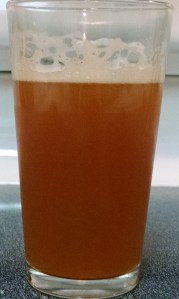
A rather turbid white stout.
The aroma is overwhelming one of coffee, to the point of a strong chemical profile. There is underlying hint of malt and acetaldehyde (not surprising considering the rushed secondary fermentation). There are no hints of chocolate on the palate or in the aroma profile. For flavor, Dave thought the white stout tasted cidery. Jess picked felt that the coffee profile masked the cider character. It is also quite turbid. After microscopic review, no yeast was observed.
So where to next? We are dumping this beer (our first dump ever). We will remake but with modifications. The coffee will be reduced greatly and the cacao nibs will be allowed to soak longer in alcohol to extract more of the chocolate flavors. We may also add the nibs to the secondary fermentation. Additionally, we will reduce the amount of lactose added to compensate for less bitterness. And we won’t rush the yeast, and may choose a different strain next time. There is a potential good beer here, buried under some mistakes.
This recipe was adapted from Experimental Homebrewing. This recipe will require us to expand our techniques in making a cacao tincture and adding lactose at packaging. Ingredients marked with a * were substitutions from the published recipe.
Grain bill:
All supplies were purchased at Hops and Berries in Fort Collins, CO. Grain suppliers varied.
14 lbs Maris Otter
0.5 lb Crystal 40L
1 lb Flaked Oats
1 lb Flaked Barley
Hops (Pellet):
1.25 oz Target (UK) 11.1% alpha acids*
0.75 oz Crystal 4.8% alpha acids
Yeast:
Wyeast 1318 London Ale III (#0829188, mfg 7/6/2016)
Specialty Ingredients:
Defatted cacao extract (4 oz raw cacao nibs soaked in 6 oz Kirkland vodka for 24 hours, strained, placed in freezer to solidify fat for removal)
Cold brewed coffee extract (1 c. ground coffee soaked in 3 c. water overnight, strained)
0.75 lb lactose dissolved in 3 c. boiling water.
Stats:
Starting gravity: 1.062
Brewhouse efficiency: 66%
Final gravity: 1.016
Approximate %ABV: 5.9%
Approximate IBUs: 67.7 (Rager)/60.9 (Tinseth)/33.2 (Garetz)/69.2 (Daniels) as determined using the Hopsteiner, ProBrewer.com, and Homebrewing.com IBU calculators.
Procedure:
Yeast was propagated in 1 L of media (0.5 c DME in 1L/~1qt water, boiled) in a 2L flask with stir bar that had been sanitized with boiling water. Media was inoculated from Wyeast Smack Pack. Propagation culture was grown at room temperature with stirring for 15 hours and was pitched directly into the cooled, oxygenated wort.
Strike temperature was 75.5 degrees Celsius. A ~2:1 water to grist ratio was achieved with 12 liters of water. Mash in temperature was 67.7 degrees Celsius, which was the desired target. Mash out was conducted at 77 degrees Celsius. Sparging was a combination fly/batch and was conducted at 75 degree Celsius until the volume of sweet wort in the boil kettle was approximately 9 gallons. Hydrometer reading of the last wort remaining in the mash tun was 4.0 Brix.
Sweet wort was brought to a vigorous boil and boiled for 90 minutes. All hop addition times are listed as time remaining in the boil. Target pellets – 60 minutes; Crystal pellets, and 1/2 tablet Whirlfloc – 10 minutes. After whirlpooling and allowing the trub to settle, the hopped wort was cooled to 20 degrees Celsius with a counter-flow plate chiller with a recirculating ice/water slurry. The hopped wort was oxygenated via an oxygen tank for 60 seconds. The yeast propagation culture (~800 mL) was pitched into the Speidel fermenter. The fermenter was placed in an incubator that was set to a maximum temperature of 20 degrees Celsius.
Primary fermentation was approaching completion at approximately 100.5 hours. Acetaldehyde was detected around 64 hours and was less noticeable at 100.5 hours. Green was transferred to secondary fermenter and was kept at 70 degrees Celsius for approximately 48 hours. The fermenter was then chilled to -2 degrees Celsius which will help precipitate proteins and any remaining yeast cells. The cold incubation proceeded for two weeks since we were traveling for vacation.
Fermentation profile of the white stout.
The beer was then transferred to a 1/3 keg. Also added to the keg were the specialty ingredients listed above. The keg was sealed, pressurized to 30 psi, and then rolled. Pressurization and rolling was repeated once. Tasting notes will follow.
Comments:
The specific gravity was lower than anticipated. During our boil, we reduced the vigor which then reduced the evaporation and thus concentration of the hopped wort. However, comparing the total Brix of the sweet (114) and hopped (91) worts, the hopped wort was approximately 20 points lower than expected. It is possible that our volume was larger than estimated, indicating that we reduced the heat too dramatically during our boil. This may result in higher DMS concentrations.
Acetaldehyde was released by the yeast, as determined by the ‘cidery’ smell during fermentation, noted around 40 hours. The aroma was less noticeable around 60 hours.
The fermentation was slower than expected. Yeast strain attenuates 70 – 75% and finishes slightly sweet (WYeast Technical Bulletin).
Initially lactose amount was 1 lb, but was reduced due to the under attenuation observed and the yeast characteristic of finishing slightly sweet; we were concerned of having the final product too sweet.
We kegged the amber ale version 3.0 2 weeks ago before we left on our Northern Rockies adventure. We have rechristened it an Imperial Amber Ale; a higher extraction efficiency resulted in a higher ABV.
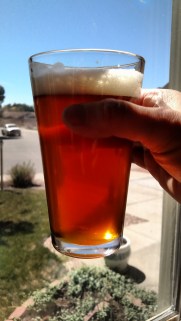
A pint of our imperial amber ale.
We are thrilled with the results of our first Colorado home brew. The color is a robust amber and the beer is clear. It is like looking through amber colored glasses. The head is white and generates lovely lacing as the glass is drained.
The aromas are of malt, dried cherries, with hints of floral and citrus. On the palate, this beer is malt forward followed by a mild bitterness. Despite the high calculated ABV, there is no alcohol burn when drinking this beer.
Only challenge we face now is reproducing this beer consistently. We hope we are wildly successful in that goal.
As discussed in a previous post we have returned our Amber Ale recipe to the development stage (water chemistry, altitude, yeast strain, hop availability).
Stats:
Starting gravity: 1.065
Brewhouse efficiency: 75%
Final gravity: 1.004
Approximate %ABV: 8.11
Approximate IBUs: 90 (Rager)/68 (Tinseth)/67 (Garetz)/131 (Daniels) as determined using the Hopsteiner, ProBrewer.com, and Homebrewing.com IBU calculators.
Grain bill:
All grains Great Western Malting and purchased through More Beer.
10 lbs 2 row domestic (#46080)
1 lb 2 row pale (#45958)
1 lb crystal 75L (#45744)
Hops (Pellet, * Whole cone):
2 oz Magnum 12.4% alpha acids
2 oz Amarillo 8.4% alpha acids
2 oz Cascade* 7.9% alpha acids
Yeast:
Wyeast 1272 American Ale II (#0721160, mfg 6/8/2016)
Water:
The city of Loveland has great water. We will pass the water through an activated charcoal filter to remove any chlorine that may be present.
Wyeast 1272 propagation culture after refrigeration.
Procedure: Yeast was propagated in 1 L of media (0.5 c DME in 1L/~1qt water, boiled) in a 3L flask with stir bar that had been sanitized with boiling water. Media was inoculated from Wyeast Smack Pack. Propagation culture was grown at room temperature with stirring for 24 hours and was then lowered to 4 degree Celsius for 18 hours.
Strike temperature was 80 degrees Celsius. A ~2:1 water to grist ratio was achieved with 11.5 liters of water. Mash in temperature was 68 degrees Celsius, 2 degrees below target. Mash out was conducted at 77 degrees Celsius. Sparging was a combination fly/batch and was conducted at 75 degree Celsius until the volume of sweet wort in the boil kettle was approximately 9 gallons. Hydrometer reading of the last wort remaining in the mash tun was 4.0 Brix.
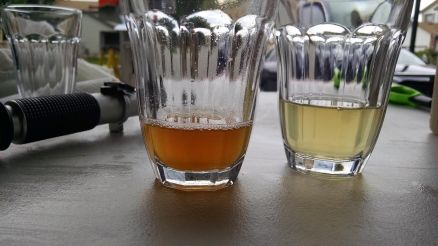
Samples of sweet wort (left) and the last runnings from the mash tun (right).
Sweet wort was brought to a vigorous boil and boiled for 90 minutes. All hop addition times are listed as time remaining in the boil. Magnum pellets – 60 minutes; Amarillo pellets, Cascade whole cone, and 1/2 tablet Whirlfloc – 5 minutes with 1/2 tablet Whirlfloc. After whirlpooling and allowing the trub to settle, the hopped wort was cooled to 20 degrees Celsius with a counter-flow plate chiller with a recirculating ice/water slurry. Liquid was decanted from the settle yeast culture until a total volume of 500 mL was achieved; the settled yeast was suspended in the remaining liquid and the yeast slurry was pitched into the Speidel fermenter. The fermenter was placed in an incubator that was set to a maximum temperature of 20 degrees Celsius.
Yeast 29.5 hours post inoculation.
Primary fermentation was complete after 72 hours and the diacetyl rest was allowed to proceed for 48 hours. The green beer was
then transferred to secondary fermenter and will be allowed to stand at room temperature for 24 hours. The fermenter will then be chilled to -2 degrees Celsius which will help precipitate proteins and any remaining yeast cells. After the cold crash, the beer will be transferred to a 1/3 keg and pressurized to 30 psi, rolled. These steps will be repeated. Tasting notes will follow.
Specific gravity and pH profile during fermentation with WYeast 1272.
Comments:
In order to achieve a faster fermentation start, we will likely shorten the propagation time for the yeast. At 24 hours, the yeast has likely entered stationary phase and may be exhausting glycogen stores due to the depletion of fermentable sugars from the media.
We started taking pH readings! Unfortunately, we forgot a reading at time point zero and did not take readings at our last two samplings. We will test the final pH of the beer.
Our brewhouse efficiency increased 10% compared to our last brew day. Possible explanations are the different water profile in Loveland, CO or a larger sparge volume. The water profile could have resulted in improved enzyme activity which increased the amount of fermentable sugars available to the yeast. A larger sparge volume would have extracted more sugars from the mash, increasing efficiency.
The 94 hour time point sample had a strong aroma, best described as ‘cidery’. This is the result of acetaldehyde released by yeast. The yeast, if reasonably healthy, will reabsorb it and scrub the green beer of this off flavor. Happy yeast makes great beer.
The estimated alcohol content takes this out of Amber Ale territory. Maybe a Red IPA? Looking forward to tasting this beer.
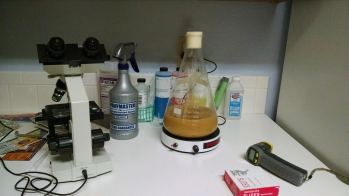
Our temporary yeast propagation and laboratory set up in the kitchen.
After a five month brewing hiatus we are preparing to brew! We decided that our Amber Ale, is going to be our inaugural Colorado brew. We last brewed this in March 2016 in Davis, CA. We were happy with the recipe we developed and already have the complete grain bill. We went to Hops & Berries South in Fort Collins to pick up yeast (Wyeast 1450) and hop pellets (Magnum, Cascade, Amarillo). It quickly became clear that we would have to deal with some unintended modifications to our recipe. Here are some of the recipe and environmental changes that we will be attempting to compensate for. Beware, this post is biochemistry heavy.
Recipe changes
Hops & Berries was out of Cascade pellets, so we purchased whole cone. This is going to lower our utilization rate because the lack of processing means the lupulin glands (source of bittering and aroma compounds) were not ruptured. When we last brewed this recipe, the Cascade pellets were added when heat was removed; with the expected lower utilization rate, the whole cone Cascade will be added with five minutes left in the boil.
Hops & Berries also sold out of the the WYeast 1450, but offered WYeast 1272 American Ale II as a substitute. 1450 is a blend of three different yeast strains, of which 1272 is one. According to the knowledgeable staff at Hops & Berries, 1272 will result in a drier finish than 1450. Increasing the mash temperature may help counteract this flavor characteristic imparted by the yeast. The flavor profile (contributions of esters, higher alcohols) of this yeast also tends towards dark fruits, such as dried cherries.
Water
This is the biggest change to our brewing. The water in Davis, CA was ‘hard’, alkaline (pH 8.2), and filled with various metals (arsenic, boron, manganese, hexavalent chromium). This link will take you to the Davis, CA water chemistry report; check out all the notifications of ions exceeding limits. The water analysis of Loveland, CO (bonus points for having a quick link on the city services website for those who rely on water quality and composition for their craft) indicated soft water, approaching neutral (pH 7.4), and few metals reported.
Why the difference in water quality? During the time we were there, Davis’ water source was multiple wells. Each well’s mineral composition is based on what is leached from the rocks, soils, and human activities in the area. If you follow the link provided above (Davis water), you will see that the values for various analytes fluctuated widely. Loveland’s water comes from reservoirs filled by snow melt from Rocky Mountain National Park. Compare the Davis and Loveland analyses. The water in Loveland in consistent month in and month out for the period it was tested. We are so glad we are not drinking water from Davis, CA anymore.
What do we predict the effect of the change in water is going to have on our beer? From personal experience, the water in Loveland tastes and smells much better than the water in Davis. That will immediately eliminate off odors and flavors from our beer that are from the water. Less chlorine will reduce the possibility of chlorophenols forming; these compounds can impart a medicine or band-aid like aroma and flavor. Loveland’s lower water hardness (less calcium and magnesium) may have a negative impact on enzyme activity (calcium stabilizes and activates alpha-amylase and magnesium is a cofactor for a variety of enzymes in yeast). However, the lower pH of the Loveland water may improve enzyme activity, negating the negative effect of low calcium concentrations. Overall, we think the differences in water chemistry are going to be a net positive for our brewing in general.
Altitude
Our elevation in Loveland, CO is 4984 feet, which we are going to say is close enough to a mile high (5280 feet). So why do we care that we are a mile high? At sea level water boils at 100 degrees Celsius and the boiling point decreases roughly 0.5 degrees Celsius for every 500 feet elevation gain. So, at Loveland’s altitude, the boiling point of water is approximately 95 degrees Celsius.
Why do we care about water boiling at a lower temperature? The off flavor dimethyl sulfide (DMS). DMS has a low threshold (easy to detect) and has an odor of canned or canned creamed corn. Not usually a flavor that is found in beer style descriptions. Please bear with the next paragraph; it is heavy in biochemistry and brewing science to provide the necessary information which will help convey the impact water’s lower boiling point.
The precursor to DMS is S-methylmethionine (SMM), which is produced during barley germination. Without germination, we would not have malt, so we cannot eliminate germination to decrease SMM. At 100 degrees Celsius (boiling point at sea level) the half-life of SMM is approximately 40 minutes. Thus, after 40 minutes, approximately 50% of SMM present would be converted to DMS. If one was boiling with vigor for 60 minutes, then 65% of SMM would be converted to DMS. DMS will be volatilized during a vigorous boil, carried off by the vapors, and will not be present in the wort (which would carry over to the beer).
95 degrees Celsius, the half-life of SMM increases to 80 minutes. So to convert 65% of the SMM to DMS, boil time would have to be increased to 2 hours. A longer boil time will increase evaporation, increase the Maillard reaction, which will increase melanoidins (flavor and color components) and potentially caramelize more sugars. Compromising and setting the boil time to 90 minutes would lessen evaporation and Maillard reactions, but approximately 45% of the original SMM amount would remain. Which could then be converted to DMS during the whirlpool stand. Without a vigorous boil, the DMS will not be volatilized and will carry over into the finished product. It’s just complicated.
Summary
We are going to just brew and see what happens. Likely modifications will be a higher mash in temperature and a 90 minute boil. Everything is about compromise. We have multiple variables changing in this brew and will find out if our compromised produced a decent beer in approximately one month.
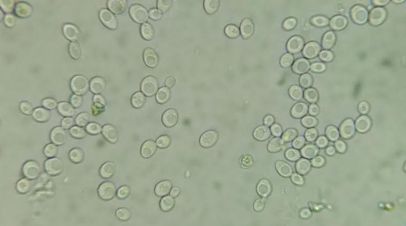
Here’s a picture of the WYeast 1272 American Ale II starter culture under the microscope after 24 hours. A reward for reading that science geek out that proceeded the summary.
Wyeast 1272 American Ale II starter culture viewed under 800x magnification.
Wanted to provide updated tasting notes on the dry-hopped Amber Ales, Amber Ale version 2, Belgian Blond, and the Vanilla Bourbon Imperial Porter (VBIP). The Belgian Blond and VBIP were initially tasted during the height of allergy season and the only thing that could be determined with any certainty was beer was being consumed. The dry-hopped Amber Ale was first tasted in mid-March prior to dry hopping. Under attenuated, under hopped, these beers were almost undrinkable. We combined the kegs and dry-hopped with 2 oz of Amarillo pellets. Finally, the Amber Ale version 2, brew day was discussed here. In a perfect world the tasting notes would have been posted two weeks ago, but clarity issues existed.
VBIP: %ABV – 9.8, IBU – data not captured
Aromas of roasted coffee, dark chocolate, and vanilla. Mouth feel is creamy. Roasted flavors with hint of vanilla and bourbon. No alcohol burn despite ABV.
Belgian Blond: %ABV – 4.9, IBU – 10
Aroma is phenolic, reminiscent of cloves. Flavor is dry, slightly astringent, with phenol character. Color is darker than expected, and is very similar to the amber ale in color.
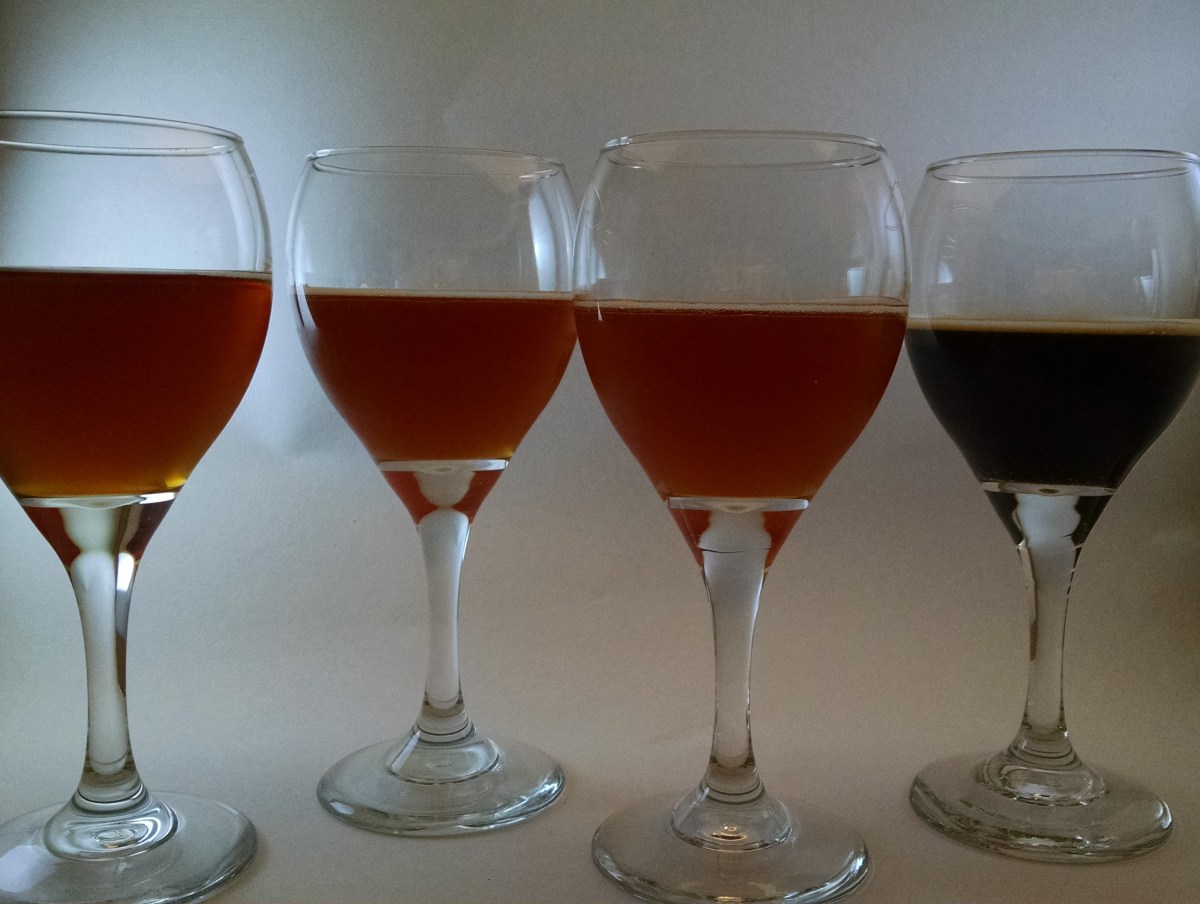
From left to right: dry-hopped amber ale; amber ale version 2.0
Dry hopped Amber Ale Combination: %ABV – ~4.79, IBU – 41
Aroma is citrus, with orange being prevalent, and malty. Sweet, but not as cloying as it was prior to dry hopping.
Amber Ale, version 2: % ABV – 6.3, IBU – 100
Aroma is citrus and malt. Flavor is sweet, with lingering bitterness that is not unpleasant. Some chill haze. Tasting notes were delayed due to microbiological haze (yeast). During transfer to the keg, some yeast was siphoned off from the secondary fermenter. Took a couple weeks for yeast to settle and to be purged from the fermenter (poured and dumped pints until clarity improved). Remaining haze is chill haze as concluded from the observation that the beer becomes clear as its temperature increases. We are pleased with this beer.
Yeast responsible for microbiological haze of amber ale, version 2.0
Back to beer! After reliving Abby’s (the RV) mechanical breakdown issues in couple of posts we decided that we needed a drink. So it seemed logical to post about our Amber Ale, version 2.0. The grain bill on this recipe is the same as what our previous amber ale brews, with increased hops, single temperature mash, and a new yeast strain.
Stats:
Starting gravity: 1.055
Final gravity: 1.007
Approximate %ABV: 6.3
Approximate IBUs: 100
Grain bill:
All grains Great Western Malting and purchased through More Beer.
pH of water was determined to be 8.2; 57 g of gypsum was added to 47L of water in the hot liquor tank which decreased the pH to 7.7
Procedure: Yeast was propagated in 1 L of media (0.5 c DME in 1L/~1qt water, boiled) in a 3L flask with stir bar that had been sanitized with boiling water. Media was inoculated from Wyeast Smack Pack. Propagation culture was grown at room temperature with stirring for 72 hours and was then transferred to a 4 degree Celsius for 24 hours.
Strike temperature was 74 degrees Celsius. A ~2:1 water to grist ratio was achieved with 11.5 liters of water. Mash in temperature was 63.3 degrees Celsius, 2 degrees below target. Mash out was conducted at 76 degrees Celsius. Mash was fly sparged at 79 degree Celsius until the volume of sweet wort in the boil kettle was approximately 8 gallons. Hydrometer reading of the last wort remaining in the mash tun was 5.0 Brix.
Sweet wort was brought to a vigorous boil. Magnum hops were added at 60 minutes, Amarillo hops added at 5 minutes with 1/2 tablet Whirlfloc, and the Cascade hops we added at heat off. After the trub settled, the hopped wort was cooled to 20 degrees Celsius with a counter-flow plate chiller with a recirculating ice/water slurry. Cooled wort was aerated with 90 seconds of oxygen through a sinter. Liquid was decanted off the top of the settle yeast, and the yeast slurry was pitched into the Speidel fermenter and left to ferment at room temperature.
Primary fermentation was complete after 72 hours and the diacetyl rest was allowed to proceed for 24 hours. The green beer was then transferred to secondary fermenter and allowed to stand at room temperature for 72 hours. The fermenter was then transferred to -1 degree Celsius for 6 days prior to kegging.
The amber ale was transferred to 1/3 keg and pressurized to 30 psi. The keg was placed on its side and rolled for approximately 2 minutes. The keg was then pressurized to 30 psi again and rolled for 5 minutes. The keg was pressurized once more to 30 psi and placed in the kegerator. We hope to have tasting notes in the next 24 to 48 hours.
Comments:
We whirlpooled twice. We did not double check the position of the boil kettle outlet, and had to turn the kettle to prevent the hoses from pinching. In turning the kettle, we disturbed the trub and had to repeat the whirlpool. This may result in a DMS problem in our beer.
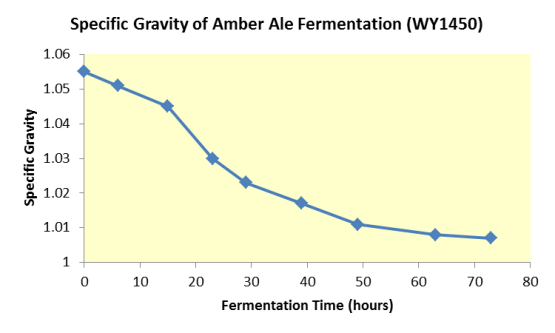
Vigorous fermentation was observed, complete attenuation reached in 72 hours. We did a much better job collecting well spaced hydrometer readings to determine gravity. For our next batch we will also take pH readings to track the fermentation progress. More DATA!
Graph of Amber Ale, version 2.0 specific gravity over the course of fermentation.
We discovered that our freezer became unplugged during the cold crash. We don’t know when, the fermenter did feel cold to the touch.
IBU values are higher than anticipated. Unfortunately, we do not have the equipment to perform an accurate assessment. We will have to determine during tasting if we decrease our hop additions.
The microscope is a fun tool. The picture below is yeast at 6 hours post pitching. The yeast looked happy. Happy yeast makes good beer.
Yeast from our Amber Ale version 2.0, 6 hours post pitching.
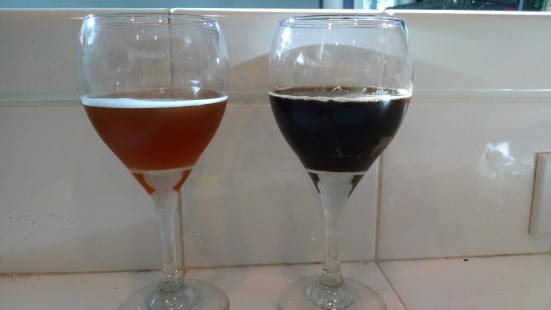
Belgian Blond (left) and Vanilla Bourbon Imperial Porter (right).
These are the tasting notes from our Belgian Blond (BB) and Vanilla Bourbon Imperial Porter (VBIP) extract/grain combination brew days. It should be noted that with this tasting Jess is suffering from allergy related stuffiness and could only be confident she drank beer; we are relying on Dave’s impressions since he is the less allergy-struck party. We will re-taste when our sinuses clear and most things no longer taste like well-chewed paper.
Belgian Blond
Original gravity: 1.043
Final gravity: 1.006
% ABV: 4.9
IBU: ~10
Visual Impressions: BB was darker than we were expecting (straw). Chill haze. Initial pour had good head, but foam stability is poor.
Aroma Impressions: Smelled strongly of cloves. No hop character. This was consistent with the aromas noted during fermentation.
Flavor Impressions: Dry. No hope bitterness. Phenolic after taste.
Vanilla Bourbon Imperial Porter
Original gravity: 1.083
Final gravity: 1.010
% ABV: 9.8
IBU: Data for calculations not captured
Visual Impressions: VBIP is dark. Initial pour had some head, but foam stability poor.
Aroma Impressions: Vanilla. Bourbon. Hint of leather (phenolic). No prominent hop aroma.
Flavor Impressions: Vanilla and bourbon present, but not overwhelming. Bitter after taste, but not harsh. Dry. Creamy mouth feel.
Notes
We forgot again and did all our fermenter and keg cleaning with water straight from the tap. The chlorination could be why the phenolic aroma is present in the VBIP and enhancing the natural phenolic character (due to yeast strain) of the BB.
The starter culture improved our attenuation. Forced fermentation wort studies will be conducted on wort batches in the future to determine final attenuation.
DATA! Still need pipetters for performing accurate dilutions, but once these are obtained, Jess is looking forward to constructing yeast growth curves to go along with the specific gravity curves. This is a late developing thought, but the pH of the fermentation can also be tracked, logged, and graphed.
This is another extract/grain kit. Not because we were short on time, but because we didn’t think far enough in advance to order our grains from More Beer for delivery by Saturday. The local home brew stores we are familiar with did not have the grains we wanted for another attempt at an amber ale. So we settled for the Belgian Blond kit from The Brewmeister.
Graph of Belgian Blond wort specific gravity during fermentation.
The milled grains were steeped at 72 degrees Celsius for 20 minutes, with the steep temperature decreasing to 70 degrees Celsius over the time course. The liquid malt extract (LME) was added to the water and mixed to ensure the mix was homogeneous. Initial volume was approximately 8 gallons. The sweet wort was brought to a vigorous boil for 60 minutes. Hop additions were made at 45 and 5 minutes (1 oz each addition). Hopped wort was cooled to 20 degrees Celsius and transferred to a Speidel 30L HDPE fermenter and aerated for 90 seconds with oxygen. The wort was inoculated with 1 L of 36 hour starter culture of WLP500. Original gravity was 1.043. Gravity readings were taken at 8 to 24 hour intervals over the course of fermentation.
What went well?
The stand proves its worth every time we brew on it.
800X bright field microscope image of WLP500 starter culture.
Captured more relevant data.
The microscope purchase was well worth it. This yeast strain had an extended lag phase and sampling the starter culture 8 hours after inoculation showed actively budding cells.
Areas for improvement
Data capture. Still need to get a form together.
Rather sporadic time intervals of gravity readings and the long gap between pitching and the next reading.
Water usage. Estimate of 4 gallons of water used for every gallon of finished beer. We will keep looking for ways to decrease our water consumption.
It was Tuesday! Jess was in class, Alex was in daycare, the sun was shining, and Dave took full advantage to brew. The selected beer was a simple Imperial Porter from Experimental Homebrewing (Beechum and Conn, pg 122) as a combination dry malt extract (DME) and grain brew (see below for malt extract/grain bill).
The milled grains were steeped at 70 degrees Celsius for 20 minutes. 6 lbs of DME was dissolved and the sweet wort was boiled for 60 minutes. Hops additions were at 4o and 10 minutes. Wort was cooled to 20 degrees Celsius and the wort was inoculated with a 1.1 L of a 36 hour starter culture. Wort was aerated with oxygen for three 30 second intervals. The Speidel 30L HDPE fermenter was transferred to a 20 degree Celsius incubator. Original gravity was 1.083.
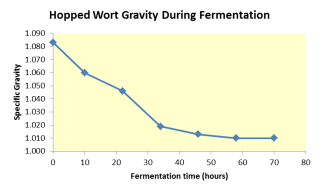
Graph of specific gravity of Imperial Porter wort.
During fermentation, specific gravity readings were taken at approximate 12 hour intervals and graphed. The final gravity achieved by fermentation was 1.010, reached by Thursday evening. On Saturday, we decided that we would transfer the Imperial Porter to a secondary fermenter and add vanilla bean (usually we just use our keg as our bright tank). Bourbon will be added at kegging, so the final beer will be a Bourbon Vanilla Imperial Porter.
What went well?
The starter culture gave led to a vigorous fermentation. Happy yeast make good beer.
Our set up. Everything went smoothly on Dave’s second brew on the system. Hoses weren’t falling on the ground and everything was consolidated in a single location.
The extract kit with specialty grain steep was easy. Doesn’t mean we are giving up whole grain, but when you need to save some time or perhaps your mash tun isn’t quite big enough to handle doubling the grain bill, DME as substitute for the base malt is easy.
Taking the gravity at intervals. It is nice knowing how the fermentation is progressing.
What went poorly?
Missed capturing some information (hop alpha acids %, weights, yeast lot number, amount of water used) but we are working on a spreadsheet to capture all the data. Yes, there are programs, but why go electronic when there is good old paper and pen?
Not that this went poorly – we are just going to have to wait ~ 2 to 3 more weeks before we can taste. Patience. Bah!
Recipe
6 lbs DME
2.75 lbs Munich Malt (10L)
1.6 lbs Brown Malt (70L)
1.38 lbs Chocolate Malt (350L)
1 lb Crystal Malt (120L)
0.5 lb Crystal Malt (60L)
0.75 oz (?) Magnum Hop Pellet (40 minutes)
0.5 oz (?) Progress Hop Pellet (10 minutes)
Whirlfloc (10 minutes)
2 vanilla beans, scrapped (into secondary) and chopped (into secondary)










 Wandervogel with the McElvains