Day 20: 01/15/2016 – Joshua Tree National Park

Day20RouteDestination: Jumbo Rocks Campground, Joshua Tree National Park

Route: I-10W, National Park Roads

Mileage: 133 miles                                New state: California

Dutch and his pup.
Dutch and his pup.

It is time to hit the road again! But before we go we spend the morning hanging out with Marilee and the Toyota crew. They are great people and it is educational to check out their rigs to see the modifications they made and pick up tips on living in a condensed space. One such person is Dutch. A Texan who met his wife in Colorado (where she is visiting family at the time of our stop in Quartzsite), they sold their house and became rubber tramps a couple of years ago. Great person to get ideas from and learn about full-time RV living. We finish up our time in Quartzsite chatting with Marilee; we need to leave in relatively good order so we can grab a site in the first come first serve Jumbo Rocks campground.
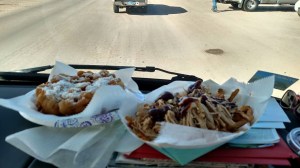
Lunch of champions: pulled pork fries and funnel cake.

As we are leaving, we decide to stop at our favorite food truck and get lunch for the road. Abandoning the poutine, we opt for the pulled pork fries and the funnel cake. Lunch of champions people. Alex got fries and pulled pork, but fruit is substituted for the funnel cake. Alex falls asleep with bits of pork on his shirt, which Penny so kindly cleans (very gently, can’t wake the toddler) off of him.

SignLA
Follow the green signs!
SignCALine
Hello California! So glad we made it.

As we approach the highway, it is straight ahead, at full speed! California, here we come! Approximately 30 minutes on the road, we see the sign we have spent 20 days driving towards – the California state line! We still have a hurdle to cross before we can be officially admitted into the state – the agricultural inspection station. As we slow down to stop, the agent just waves us through and seems annoyed that we slowed down. Onward!

We reach exit 168 that will take us into Jumbo Rocks. As we are approaching the park entrance, who do we see boon-docking on BLM land? The Wynns from Gone with the Wynns! The solar array on their motorhome and teal logo on their smart car are pretty solid identifiers. Full-timers in a class A, we have picked up helpful tips and hints from their website. Especially in the regard to solar power and coach batteries. A quick stop to say hi and thanks for the inspiration, and we are on the road enter Joshua Tree National Park.

Joshua Tree is located where the Mojave (western half of park, 3000 feet plus above sea level) and Colorado (eastern half of park, below 3000 feet above sea level) deserts converge. Mojave flora includes pinyon pines, junipers, scrub oaks, Mojave yuccas, Mojave prickly pear cacti, Parry’s nolina, and, of course, the Joshua tree (a species of yucca). Mojave fauna includes antelope ground squirrel, yucca night lizard, black-tailed jackrabbit, common raven, American kestrel, loggerhead shrike, red-tailed hawk, Scott’s oriole, western screech owl, and the southwester speckled rattlesnake. The Colorado desert’s flora includes palo verde, ocotillo, smoke tree, brittlebush, chuparosa, sand verbena, pencil cholla, and dune primrose. The kit fox, kangaroo rat, zebratail lizard, LeConte’s thrasher, tiny checkerspot butterfly, and the western diamondback rattle snake are the fauna that inhabit the Colorado desert.

The piles of boulders are impressive to see.  The rocks are granite, formed by magma intruding on the Pinto genesis formation underground. As the granite cooled, horizontal and vertical cracks were formed. As the granite was uplifted, ground water caused chemical weathering, which widened the cracks and rounded the edges. The soil eroded, resulting in the heaps of monzogranite seen today.

We arrive at Jumbo Rocks, and there aren’t many spots left. Fortunately, there are a couple of other campground options that we drove by that seemed sparsely populated with campers. Luck was on our side, and we found a spot to wedge ourselves into. Not nearly as bad as our first night at Big Bend, but not ideal. After we settle in, we take a short hike to Skull Rock. Nothing too strenuous and it gets us out of the RV after the day’s drive. We don’t want to be gone too long since there is a special program at the amphitheater tonight.

While we are eating dinner, there is a knock on the door. It was Ranger Doug informing us about the program at the amphitheater. We had planned on going, hence the early dinner time, and finish up so we can be on time. The desert night is a bit chilly, so we bundle up and walk to the amphitheater. Ranger Doug is traveling across the country informing people about the posters the WPA (remember those school lessons about the New Deal?) printed for the National Parks between 1938 and 1941. Many of the original posters have been lost or forgotten in archives. Multiple versions for a single park have also been discovered. It is a fascinating talk at the time and effort into the reproduction process is staggering. If the opportunity presents itself to hear Ranger Doug speak, one should seize it; he is enthusiastic in his mission and knowledgeable. As always, it is early to bed, for what we hope is an early to rise.
February 28, 2016: Amber Ale 2 Ways

It has been a month since we last brewed, and we need to have the new beer ready before the previous batch runs out. Today we have two objectives.

  1. The inaugural brew on our new set-up and test the ice bath as an effective chilled water source for cooling wort.
  2. Test the effect on beer flavor of mashing in at ‘protein-rest’ temperature (~45 degrees Celsius) vs mashing in at conversion temperature (~65  degrees Celsius).

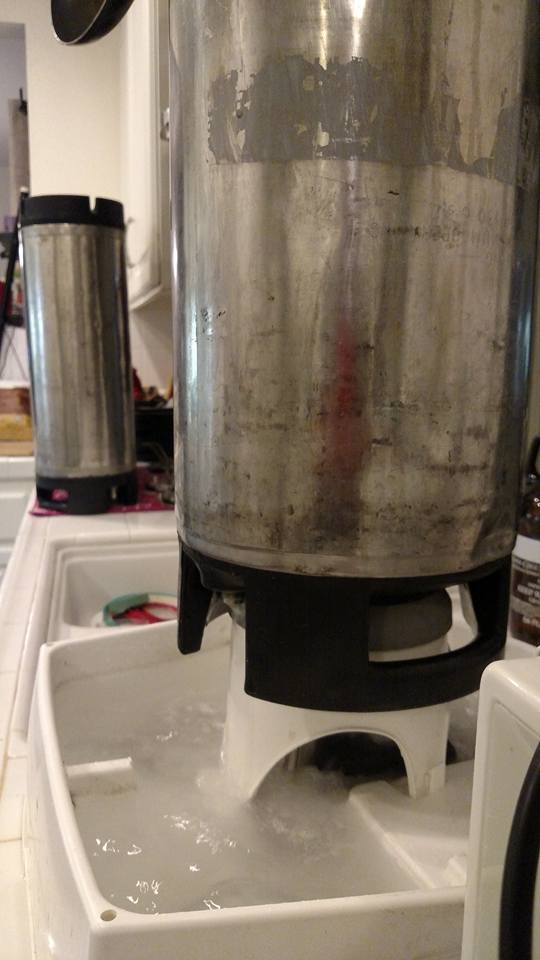
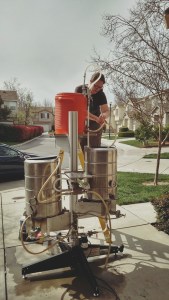
Objective one was completed rather successfully. The system needs further optimization, but overall, the brew day went very smoothly. We discovered we could not fit the brew stand through the gate to the back yard. So we brewed in the driveway. We met more neighbors in a few hours of brewing than we had in an entire month. We were able to cool 4 gallons of wort to 20 degrees Celsius with 5 gallons of water with 10 pounds of ice. The water out from the heat exchanger was added back to the ice bath. By the time the wort was cooled, the ice had melted, but no significant increase to the water temperature was observed. Got to love the isothermal nature of a phase change.

Objective two is to determine if a low temperature ‘protein-rest’ will affect the beer flavor/aroma/mouth feel. We are more concerned with residual B-glucanase activity. Depending on one’s school of thought, this enzyme might have been inactivated in the malting process during kilning, but there is anecdotal evidence that a low temperature rest may result in the break down of B-glucans. With any luck, the result of both experiments will be a drinkable beer. Recipe is listed below, with identical recipes used for each experiment.

Grain Bill: 12 lbs Domestic 2-Row, 1 lb American Pale, 1 lb Crystal 75 L

Hops (Pellets): 0.5 oz Magnum (12.1% AA) 60′, 1 oz Willamette (5.1% AA) 15′

Boil Kettle Volume: 7.5 gallons

Cellar Volume: 4 gallons

Yeast: White Labs PurePitch WLP002 British Ale

Experiment 1 Gravity: 1.0611

Experiment 1 Efficiency: 59%

Experiment 2 Gravity: TBD

Experiment 2 Efficiency: 59.5%

Experiment 1: Mash-in at 48 degrees Celsius and rest for 20 minutes. 2:1 water to grist ratio (w:w). Using the plate heat exchanger, recirculate wort to increase temperature to 64 degrees Celsius and allow conversion to proceed for 30 minutes. Sparge at 72 degrees Celsius. Boil for one hour, whirlpool. Fermentation temperature 20 degrees Celsius.

Experiment 2: Mash-in at 64 degrees Celsius and allow conversion to proceed for 30 minutes. 2:1 water to grist ratio (w:w).  Sparge at 72 degrees Celsius. Boil for one hour, whirlpool. Fermentation temperature 20 degrees Celsius.

Observations: 

  1. Experiment 1 mash-in temperature was a higher than desired, and conversion temperature was lower than target (67 degrees Celsius). To ensure that the only variable was the ‘protein-rest’, experiment 2 conversion temperatures were also modified.
  2. Experiment 2 the fly sparge became a batch sparge due to an airlock in the pump, thus adding another variable to our experiment.
  3. At the end of our sparge, the wort was tested. The reading was ~7 degrees Plato. There is still sugar to be recovered. We could slow down our sparge rate to increase efficiency of sugar recovery. This will also increase the recovery of undesirable compounds (tannins, polyphenols).
  4. We experienced a greater boil off than anticipated based on our experiences from a month ago. It should be noted that we had a much stronger boil an greater evaporation because we were not fighting the wind to keep a constant flame as we had to do our previous brew day.
  5. We used approximately 40 gallons of water to generate 8 gallons of beer.
  6. Fermentation started Monday morning.

Brewing System Upgrades

Jess transferring sweet wort from the mash tun to the boil kettle.

We were frustrated with our set up the last time we brewed. What annoyed us? Clean hoses on the ground, pump on the ground, unstable set up for our gravity sparge system, and a large amount of water used/wasted to cool our wort were just a few of the things that got under our skin while we worked. So the following purchases were made: Blichmann Top Tier Modular Brewing Stand, a centrifugal Chugger Pump, a sparge arm, a whirpool paddle, and other miscellaneous supplies (tubing, quick connectors, gaskets, etc). Our first brew with the new equipment is detailed here.

The new system still needs to be optimized, but overall it was a fantastic brewing experience. We were able to move almost everything off of the ground with the Blichmann stand, and only needed to re-purpose a patio table for our ice bath. The sparge arm is over-sized for our mash tun, so the only option is to get a larger mash tun! The second pump expands our capabilities to easy adjustment of temperature of the wort to allow for rudimentary temperature program mashes and a more effective mash out. The addition of the second pump also allowed us to recirculate to an ice bath to chill our wort. This significantly reduced our water usage and time to cool the wort to fermentation temperature. The whirlpool paddle was another fantastic investment. The result was a well formed trub cone and bright wort.