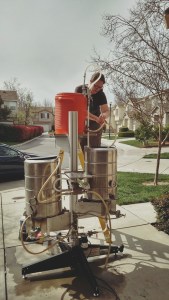
Jess transferring sweet wort from the mash tun to the boil kettle.
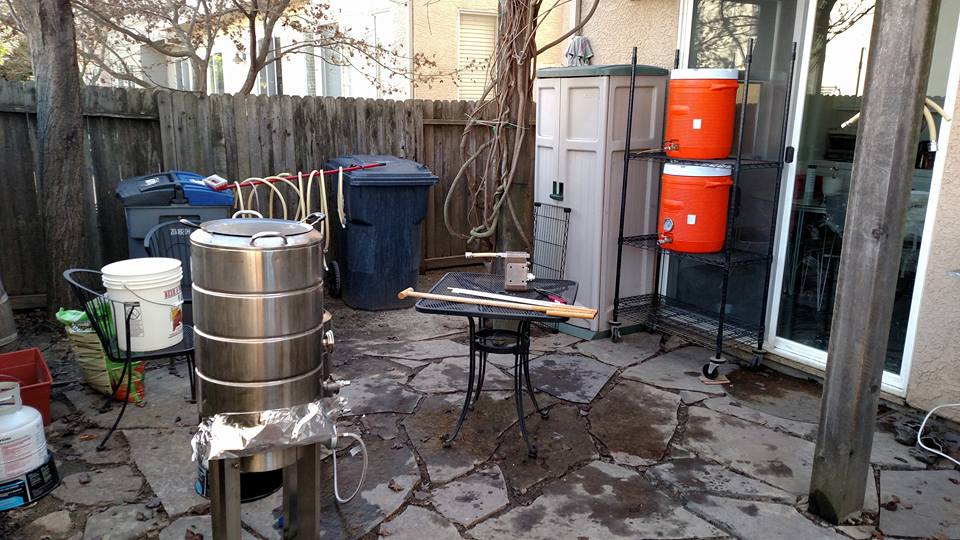
We were frustrated with our set up the last time we brewed. What annoyed us? Clean hoses on the ground, pump on the ground, unstable set up for our gravity sparge system, and a large amount of water used/wasted to cool our wort were just a few of the things that got under our skin while we worked. So the following purchases were made: Blichmann Top Tier Modular Brewing Stand, a centrifugal Chugger Pump, a sparge arm, a whirpool paddle, and other miscellaneous supplies (tubing, quick connectors, gaskets, etc). Our first brew with the new equipment is detailed here.
The new system still needs to be optimized, but overall it was a fantastic brewing experience. We were able to move almost everything off of the ground with the Blichmann stand, and only needed to re-purpose a patio table for our ice bath. The sparge arm is over-sized for our mash tun, so the only option is to get a larger mash tun! The second pump expands our capabilities to easy adjustment of temperature of the wort to allow for rudimentary temperature program mashes and a more effective mash out. The addition of the second pump also allowed us to recirculate to an ice bath to chill our wort. This significantly reduced our water usage and time to cool the wort to fermentation temperature. The whirlpool paddle was another fantastic investment. The result was a well formed trub cone and bright wort.
We are on the road again after a hospitality filled stop with Nils and Felicia! We are off to Quartzsite, AZ to meet Dave’s cousins Tom and Marilee at an RV rally for Toyota chassis RVs. We will be parking in the SOB (Some Other Brand) section of the Toyota group, which we can only hope is not next to portable toilets.
Quartzsite’s population, as determined by the 2010 census, was 3,677. The population swells during the winter months as RV, looking to escape the snow and cold, descend like locusts to enjoy average high temperatures in the mid-60s to mid-70s. Folks leave before the summer heat begins. National Geographic Magazinesets the scene.
By mid-January the mechanical car counter at the Interstate 10 exit is ticking off 26,000 vehicles a day. Within weeks 175,000 RVs cram inches apart into 9 trailer parks, onto front yards, and spill out seven miles on either side of town. Every year more than a million people reset their internal navigation and drive from Everywhere, North America, to this western Arizona dot on the map. Luxury motor homes, fifth wheels, cab-over campers, trailers, and converted school buses plunk down on the same patch of land.
Abby hiding among the Toyotas
We arrive and are welcomed warmly by the group. Abby is a giant among the Toyotas and we tuck ourselves in at the end of the area roped off for the group. There is nary a porta-potty in sight. Marilee is still traveling from Pasadena, CA, so we settle in and decide to go exploring.
Driver side of the converted school bus.Passenger side of the converted school bus.
The National Geographic description is spot on. RVs keep pouring into campsites in town as well as heading to the surrounding BLM land. And they are coming in various shapes and sizes. Our walk down down the main drag brings us across this converted school bus. Not the most luxurious vehicle out there, but it gets the job done. The artwork is rather impressive. We are thrilled when we discover a food truck with poutine! True poutine with cheese curds, it is not. But the fries are hand cut and the gravy is quite decent. It is topped with mozarella cheese, but we can’t be poutine purists in Arizona. It is a fantastic mid-afternoon snack and Alex approves.
Refreshed, we continue our wanderings. If you need to find something for your RV, there is likely a vendor here selling the part or can get the part for you. Crossing Central Boulevard, the swap meet expands to epic proportions. If you need some sort of mineral, you need to visit Quartzsite. We start browsing the display trailers at the RV show; no intent to replace Abby, just curious to see what is out there and we don’t make it past the fifth wheels. There are some appealing floor plans, like the one with a second bedroom. It might be nice sleeping more than 3 feet away from Alex.
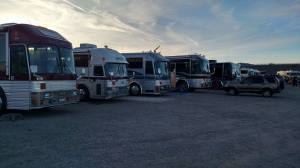
Converted buses in Quartzsite, AZ
With the display trailers being locked up, we abandon exploring and head back to camp to chat with Marilee and get dinner going. The converted bus contingent has grown stronger in our absence.
We have a schedule to keep, and Guy and Sharon have commitments. We had a wonderful visit and hit the road around 9 am. Guy gave us some excellent advice on a scenic route to Oro Valley. Since we can’t achieve 65 mph anyway on the highway anyway, the scenic route fits right into our agenda.
Cell phone photo of the VLA.
The drive does not disappoint. We drive by the NRAO Very Large Array (VLA – think the movie ‘Contact’) and are surprised that it is so compact. We cross railroad tracks and discover, with a bit of research, that the tracks are for moving the arrays around the valley. There are beautiful high mountain meadows along the drive.
We see snow again the Gila National Forest, and, alas for Penny, do not stop. It should be noted that this part of the trip is pretty desolate and there are not many opportunities for gas and even fewer for diesel. We are glad for the topped of tank before leaving Socorro and stop in Safford, AZ to fill up and purchase Powerball tickets (did not win).
On I-10, it is very strange to see so much traffic after the isolation in West Texas and New Mexico. We arrive at our friends Nils and Felicia’s house around 7 to a delicious dinner. The dogs are thrilled to be allowed into the house; all our previous stops they stayed in the RV overnight. Alex is put to bed and laundry is done while catching up.
Dave hard at work at RestoCycle
The next day, Nils takes Dave to visit his business, RestoCycle, which does vapor blasting and restores Japanese motorcycles. Jess, sensing that this trip could take awhile, opts to relax at the house with Alex and Felicia. This is a wise call because Dave is shanghaied into motorcycle repair. Although, one could argue, he seems awful happy about it. Another fantastic dinner and off for to sleep on a real mattress one last time before our final week in the RV. It was a great rejuvenation stop with Nils and Felicia.
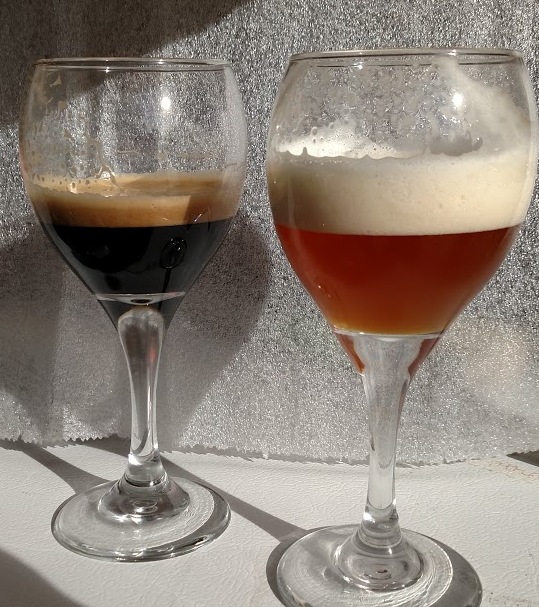
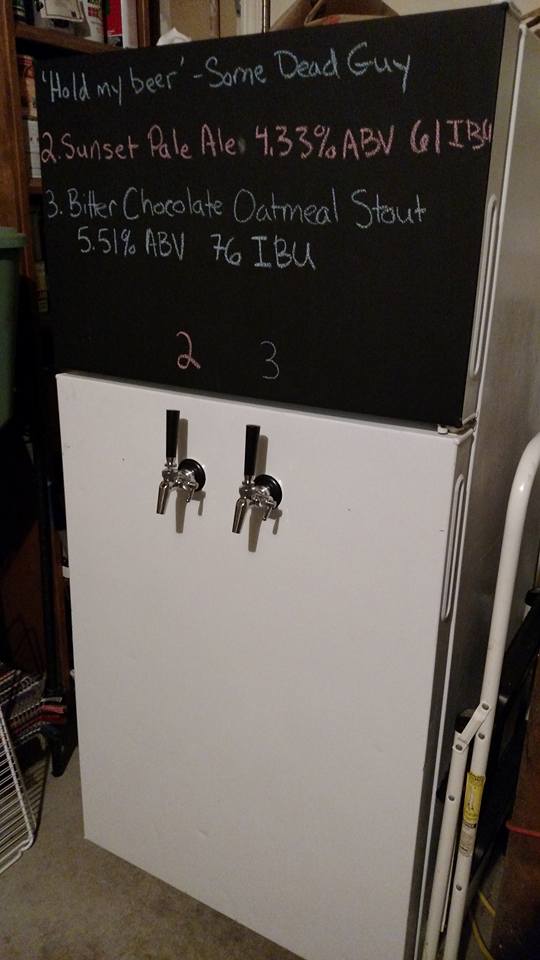
First tasting of the beers was 2/13/2016. A second tasting was conducted on 2/18/2016. Of course we drank the beers between tastings! Check out this post for details for brew day and this post for details from kegging day.
Overall, we are pleased with the beers and continue to learn through the process.
Sunset Pale Ale:
2/13/2016 – Golden in appearance with a hint of red. Beer is cloudy. Excellent foam. Aroma was piney hop notes with underlying citrus. Drier finish that is bitter and slight astringent. Lingering bitterness, but not unpleasant. Paired well with food, especially foods with higher fat content (think cheese). Beer was tasted in the early afternoon.
2/18/2016 – Piney hop notes are diminished and there is now an oxidized character to the aroma. The chemical responsible for this character is trans-2-nonenal. Bitterness reduced and astringency increased. Tasting was done early evening.
Off aromas likely from oxidation due to a poor keg purge. There was also a significant amount of head space in the keg after beer was transferred in. Keg was also rinsed with chlorinated water instead of water passed through a charcoal filter. We will see if any aromas that could be attributed to 2,6-dichlorphenol. We also do not know what our water chemistry is at our rental; the chemistry could impact the flavor and stability of the beer, and may impact the pale ale style more significantly than others. It is fun operating in the blind.
Bitter Chocolate Oatmeal Stout:
2/13/2016 – Dark brown, almost black in appearance. Excellent foam that was very stable. To borrow from wine tasting, the beer has ‘legs’ and coats the glass after swirling. Aroma contained roasted, chocolate and coffee characteristics. No noticeable hop character. Sweet and bitter characters with a silky mouth feel. Lingering bitterness, but not unpleasant. Beer is drinkable, and is filling. Gravity reading and %ABV need to be redone – it feels like it has and ABV higher than 5.5%. Beer was tasted in the early afternoon.
2/18/2016 – Aroma similar, perhaps with a hint of hop starting to come through. No major differences between tastings.
Today we head to Socorro, NM to visit with Dave’s cousin Guy and Guy’s wife Sharon. They have horses so we have been working hard with Alex that horses are not cows and therefore say ‘neigh’ not ‘moo’. It doesn’t appear to be sticking.
We arrive to a warm welcome and settle in. We originally planned to stay in the RV, but after looking at the weather forecast, we opt for the guest house. The temperatures are supposed to drop into the high teens, too cold for us to stay in Abby.
Settlement on our house is coming up in a few days. We confirm we filled out the paperwork properly and fax the notarized documents back to Dave’s real estate office in Delaware.
After a relaxing dinner, we break out Horse Monopoly once Alex is down for the night. It is a game filled with shifting alliances, business deals gone bad, and a mega-merger. The conglomerate is successful in driving the smaller mom and pop shop out of business and the conversations are a bit testy by the end of the night. Best quote of the night is aimed at Guy by his daughter. ‘It is awful convenient that you decide to become a Democrat in order to win at Horse Monopoly.’
Alex hiking in a Canyon near Socorro, NM.
Monday we take the dogs and Alex for a hike on some BLM land with Guy and Sharon. The dogs are thrilled to run around and Penny even got to roll in snow that remained in the shady portions of the canyon. Alex is so tired, he falls asleep after 5 minutes in the car.
Later that day we go to the Bosque del Apache National Wildlife Refuge. The sandhill cranes aren’t cooperating, but we see a blue heron, ducks (so many ducks), and a mule deer. On the bright side, Alex can clearly identify a horse and even clucked at the chickens.
We have a fabulous time, but need to hit the road again January 12 so Guy and Sharon can return to their regular schedule and to make sure we arrive on time in Davis.
This is a continuation of the home brew we started January 31, 2016.
Fermentation was finished by February 5, 2016. The couple days intended for the diacetyl rest stretched into about four. After sampling the green beer to obtain a gravity reading, we dropped the temperature to 2 degrees Celsius to facilitate chill haze formation and precipitation. After letting the beer rest a couple more days, we plopped Alex in front of the electronic babysitter while we sanitized and carbon dioxide purged our kegs and transferred the beer. All calculations were performed using the tools found on Brewer’s Friend.
‘. . . There’s a feeling I get when I look to the west and my spirit is crying for leaving . . . . Yes, there are two paths you can go by but in the long run there’s still time to change the road you’re on . . .’
So, we decided to take a break from chronicling our move to California to start our home brew diary! So if you are reading this and wondering how we are brewing on the road, well, we are not. The chronicles of our westward journey are being provided after the fact. We arrived at our rental in Davis, CA on January 20, 2016. Perhaps we should have altered you, gentle reader, that this paragraph contained spoilers. Ah well. Check out our travel posts. At the minimum, there are some pretty pictures.
On our travels, we just happened to pass by Concord, CA, home of a More Beer! retail store. Of course we stopped. And bought two all grain kits: Sunset Pale Ale (#583) and Stone’s Bitter Chocolate Oatmeal Stout (#800). The goal was to brew the beautiful weekend of January 23rd, but common sense prevailed. We decided to postpone until we got better settled into our new home and Dave reassembled the brew equipment.
What went right
Strike water temperature to achieve the correct mash. Jess took the time to calculate the heat input required to raise the malt to mashing temperature (Q=m*Cp*(T2-T1); where Cp of the mash is estimated at 1680 J/kg*Celsius). This heat input was then used to calculate the temperature the strike water needed to be heated to in order to achieve the desired temperature at mash in.
Alex enjoyed tasting the malted barley and helping wash and sanitize the hoses. As long what is being cleaned isn’t Alex’s face or hands, he is all for it. He was a good brewer’s assistant. Never fear, once the propane burners were lit, he was safely inside.
What went wrong
The weather. A cooler day, the constant breeze illustrated the powers of convection. Throw in the fact that the wind blew out our burners a couple of times, it is no wonder it took so long to heat our liquids.
Shaking the dust off. It was series of little things because we haven’t brewed in a couple of months. Finding the proper hose with the right couplings, a kettle that was leaking due to the gaskets, remembering that the pump needed to be primed. Those small things add up to some serious lost time.
Chocolate nibs are an impressive clogging agent, especially coupled with a plate chiller. This only emphasizes how our process needs to be refined. We will get there. Nothing a little whirlpool action and some filtration won’t solve.
The amount of water we needed to use to chill our wort. We definitely need to improve our water conservation. Or hide our usage from our neighbor. The target is conservation.
Hops (Pellets): 1 oz Amarillo 8.5% AA 60′, 0.5 oz Northern Brewer 7.0% AA 30′, 0.5 oz Cascade 5.5% AA 10′, 1 oz Amarillo 8.5% AA 5′, 1 oz Tettnanger 4.6% AA dry hop
Yeast: White Labs Pure Pitch WLP001 California Ale
Original Gravity: 1.059
Final Gravity: TBD
Fermentation Temp: 20 Celsius
Observations:
Fermentation started by Monday morning.
Stone’s Bitter Chocolate Oatmeal Stout
Grain Bill: 15 lbs Two Row, 2 lbs Flaked Oats, 1.5 lbs Pale Chocolate Malt, 1 lb Black Patent, 1 lb Roasted Barley, 1 lb Crystal 15 L, 8 oz Carapils
Hops (Pellets): 4 oz Willamette
Additions: 4 oz Cacao Nibs added with 15′ left in boil
Yeast: White Labs PurePitch WLP001 California Ale
Original Gravity: 1.090
Final Gravity: TBD
Fermentation Temp: 20 Celsius
Observations:
After mash was finished, the air bubbles on top of the grain bed were multi-colored which is indicative of a good mash.
A lot of trub at end. Clogged the plate chiller pretty quickly.
Today is a day trip to Carlsbad Caverns! Well, with a side trip to the Carlsbad, NM proper for some fun with house sale closing documents. Our house went under contract in December 2015 and since we are clearly no longer in Delaware, we are doing something called ‘signing outside of closing’. In other words we sign all the documents prior to closing, scan the signed documents, email the pdf files back to our closing coordinator, and get the originals in the mail to return to the coordinator post haste. If all is timed just right the originals will be in the attorney’s hands the day of closing. If all does not go well, the electronic documents suffice while the originals documents enjoy the hospitality of the USPS.
The closing documents arrived via email Friday and we printed all the documents in the Carlsbad public library. What we need on a lovely Saturday morning is a notary to witness and notarize several of the documents. As luck would have it, the Wells Fargo in Carlsbad has a public notary. We spend approximately an hour waiting for the notary, one of the bank managers. Papers signed and notarized, we continue south to the caverns.
Abby parked at the Carlsbad Caverns visitors center.
We arrive at the caverns and get Abby and the dogs tucked away. It is a cool and partly cloudy day so the dogs will be find hanging out in the RV with plenty of water and the ceiling vents cracked. We initially forget our National Parks Annual Pass, and Dave returns to the RV to get the pass. This will save us the admission fee and paid for itself on our 2015 RV trip.
Going into a hole in the ground.
The elevator to the caverns is broken with an unknown repair date (weeks, months, years?). We are going to have to hike in and out of the caverns. Alex is snug in his Osprey and we head towards the natural entrance. Just before we enter, a ranger goes through the rules of the caverns – no food, no throwing coins in pools, don’t touch the rock formations, and no loud voices are among some of the don’ts. We have some misgivings about being able to comply with the no loud voices with Alex, who has just entered a shrieking stage. This could be interesting.
The natural entrance after our initial descent.
As we start our descent, Alex lets out a couple good shrieks and discovers – ECHOES! And continues making a wide variety of noises and giggling hysterically at the echoes. Fortunately, Alex settles in and stops the loudest noises before we get too far into the cavern. The walk down is rather steep in some places and deceiving. We reach a point where the descent seems to stop and think we have reached the bottom. It is just a brief breather before the second, steeper descent begins. It is going to be an interesting climb out.
On the descent to the Big Room
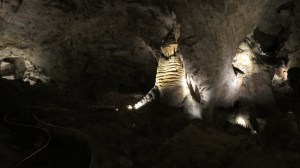
Due to our late start, we follow the advice of the rangers and push through the descent quickly in the hopes of seeing the Big Room in its entirety. Walking in is off-putting. The lighting was done by a stage lighting expert the majority of the path is in shadow and you often discover the angle of the slope only after you have started to walk down it. We make good time and start our journey through the Big Room.
Lion’s tail.
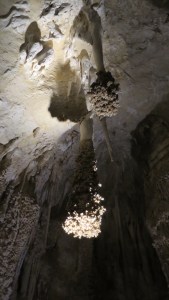
It is fascinating how many different forms the rock takes. The caverns were formed by hydrogen sulfide rich water migrating through the fractures and faults of the Capitan limestone. When the water mixed with oxygen, sulfuric acid was formed and dissolved the limestone, creating the caverns. Gypsum (calcium sulfate), silt and clay deposits were left behind. As the water levels dropped, speleotherms (cave formations) started to develop, but this action ceased approximately 4 million years ago.
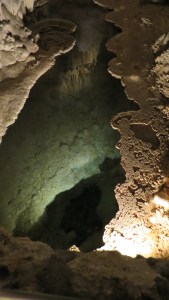
SpeleothermCavern pool.
We also learn that it takes approximately 8 months for surface water to make it into the caverns. The National Parks Service has inadvertently altered the flow of water into the caverns with the construction of roadways the visitors center. These structures increase water run off and divert water from percolating into the caverns. Years of drought have also been detrimental to the amount of water entering the caverns. The water in the cavern pools is high susceptible to contamination when people throw in coins. Minerals leach out of the coins and foul the pools; the water is stagnant and the contaminants are not washed away.
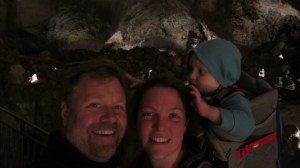
Speleotherm formation.Hiking in the caverns. Alex is fixing our hair.
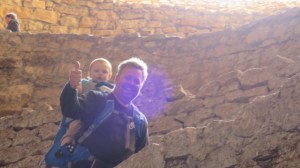
We encounter a ranger at an intersection of two trails. We can go the longer route, which will take about an hour, or we can take the cutoff and be out of the Big Room in about 20 minutes. We choose the longer route. We are glad we did. We look into the lower caverns and the ‘bottomless pit’. It is hard to imaging exploring these caverns without the modern conveniences of high intensity lamps or the walkways. The early explorers of the caverns were very brave people. The Big Room complete, we take a 15 minute break in the cafeteria to prepare to the walk out of the caverns. Dave takes Alex and packs him out into the daylight.
Dave carrying Alex out of the caverns.
Overall, we have a great experience at Carlsbad Caverns. There were very few people in the caverns, perhaps due to the main elevators being out or the fact that it is early January. Whatever the reason, it made the experience very enjoyable.
In terms of days, we have reached the halfway point of our travels! We have also continued making good progress in a westerly direction. We leave Big Bend and head north towards Alpine, TX. It is a very long, very desolate drive. We notice ranches all along our route and see a half dozen cows at best. The low number of cow sightings might be due to the complete lack of forage. Just south of Alpine we get to interact with other humans! Specifically, at a US border patrol station where they are conducting a citizenship check. A simple answer of ‘yes’ to the question are you citizens, and we are allowed to continue on our journey.
As we get closer to Alpine, we start to climb and the town seems more appropriately named. In Alpine, we are hoping to stop at the Big Bend Brewing Company for lunch, but a quick perusal of their website indicates no food, so we push on. As we continue on 90, we start to get pushed around by some big winds. It is a fight to keep Abby steady on the road, so we bleed off speed to make her easier to control. We decide to stop in Marfa for lunch. This little town is odd in the fact that there are some very nice ($$$) restaurants. We opt for the Dairy Queen. While Jess is inside ordering, Dave enjoys the return of data coverage and is reviewing the weather for Guadalupe Mountain National Park, our targeted camping location. It is supposed to get rather cold tonight.
Dave takes the wheel after lunch and gets to enjoy rain/snow showers in addition to the gusting wind. We continue on and driving conditions improve when we reach TX-54N. The sun comes out and the winds die down. The landscape appears rather inhospitable, and then the Guadalupe Mountains rise up out of the desert, appearing lush in comparison to their desert surroundings. These mountains were used by the Nde (Mescalero Apache) as hunting grounds; elk mule deer, wild turkeys, mountain lions, black bears, golden eagles, and peregrine falcons can be found at higher elevations. These animals live in a dense forest of ponderosa pine, southwestern white pine, Douglas fir, and aspen that is reminiscent of the cooler and moisture climate of 15,000 years ago. For explorers and pioneers, the mountains served as a landmark with valuable water and shelter.
When we arrive at the Guadalupe Mountain National Park visitors center, there is snow on the ground. At the visitors center, we learn that the Guadalupe Mountains are an exposed fossil reef that formed 260 – 270 million years ago. A tropical ocean covered portions of Texas and New Mexico. The reef was composed of calcareous sponges, algae, and other lime-secreting marine organisms. They, along with the lime, form the horseshoe-shaped Capitan reef. Over time, the sea evaporated and the reef was buried in layers of sediments and mineral salts and remained entombed for millions of years. During a mountain-building uplift, part of the reef was exposed in the Guadalupe, Apache, and Glass Mountains. Carlsbad Caverns are also part of this exposed reef.
We recheck the weather forecast and the lows for the night are forecast in the 20s, winds steady at 30 – 40 mph, with gusts up to 60 mph. We decide to check out the RV camping area and get some fresh water. While the water tank is slowly filling (extremely low pressure), Penny and Chewie romp in the snow. Penny is absolutely thrilled to roll in the snow and enjoys herself thoroughly.
Guadalupe Mountain National Park Pine Springs RV Campground.
The RV camping is a bit disappointing, just extra large spots in a parking lot at a trail head. There is very little shelter and the wind is really beginning to whip. After a brief discussion, we decide that we cannot spend the night here. We have no arctic package, the cold will tax our batteries, and the furnace will likely run all night (further taxing our batteries and reducing our propane). We look at the map and decide to push on to Brantley Lake State Park in New Mexico.
Destination: Brantley Lake State Park, NM
Route: US-180E, US-62E
Mileage: 75
New States: New Mexico
Brantley Lake is our scheduled overnight stop for Day 14. We know we will have an electric hook-up so we can run the space heater. This will save wear and tear on our batteries and our propane supply. We arrive after the welcome center has closed, so we fill out the self pay form and ensconce ourselves into site 24.
Prison style toilet and Brantley Lake State Park
The campground is very nice. The sites are spacious and level with a very nice picnic pavilion. There is a playground for Alex to enjoy during daylight hours and the bath house is clean. We have one complaint about the toilets . . . according to Dave, a wee bit cold in the poorly heated bathrooms. This confirms the choice Jess made to use the RV bathroom.
We are sad that Guadalupe Mountain National Park did not work out for us due to the weather conditions. The hiking trails are extensive and we are putting this on the list to return to. Next trip we will check out Dog Canyon, which is at the northern boundary of the park and accessible from New Mexico.












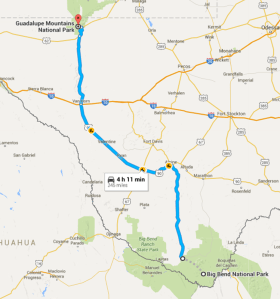 Destination: Guadalupe Mountains National Park
 Destination: Brantley Lake State Park, NM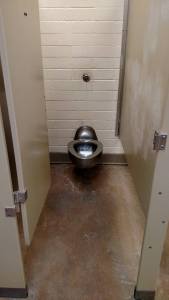
 Wandervogel with the McElvains