March 20, 2016: Tasting Notes – Amber Ale Update

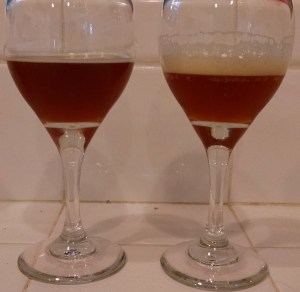
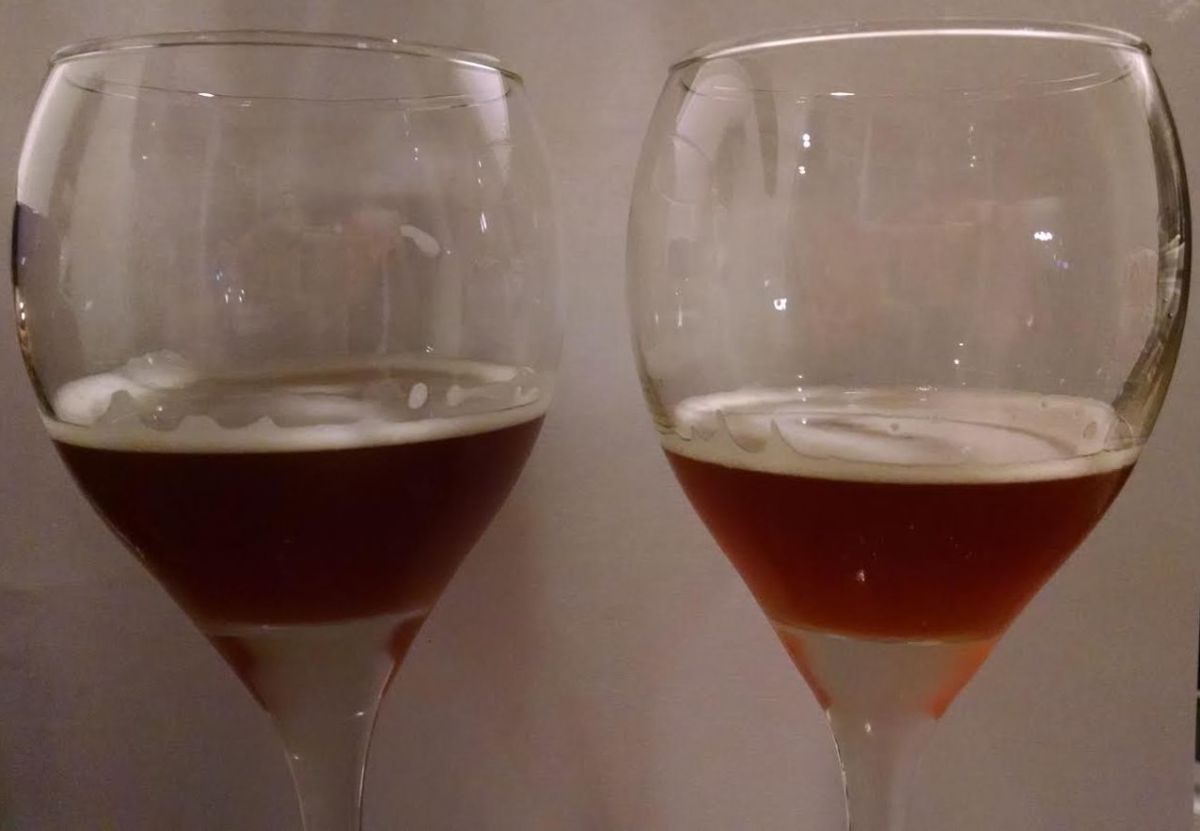
Two temperature mash on left, single temperature on right.

So an update on our poor, under-attenuated amber ales. We have been discussing dumping them because we are going to need the kegerator space. However, they earned a reprieve when 1. our bitter chocolate oatmeal stout keg kicked and freed up space and 2. we decided to make a vanilla bourbon stout that will need to be racked for 10 – 14 days. So, the amber ales survive!

We decided to see if anything has changed in the past week since our first tasting and we were pleasantly surprised! The picture doesn’t do the clarity justice (a light box will be added to the to be purchased list), but the beer is clear! Especially the single temperature mash. We are also pleased the quantity and stability of the single mash foam. These two beers were poured within a minute of each other and the picture taken within a couple minutes of pour. The flavor of both beers is still sweet and under-hopped. The two temperature mash has a drier finish hidden under the residual sweetness.

So what to do next? Since their dates with drain destiny have been placed on hold, we might as well dry hop the amber ales and see if they improve.

Founding of our QA/QC Microbiology Laboratory

The new toys arrived today! So what did we purchase and why?

  • Alex checking out the microscope.
    Alex checking out the microscope.

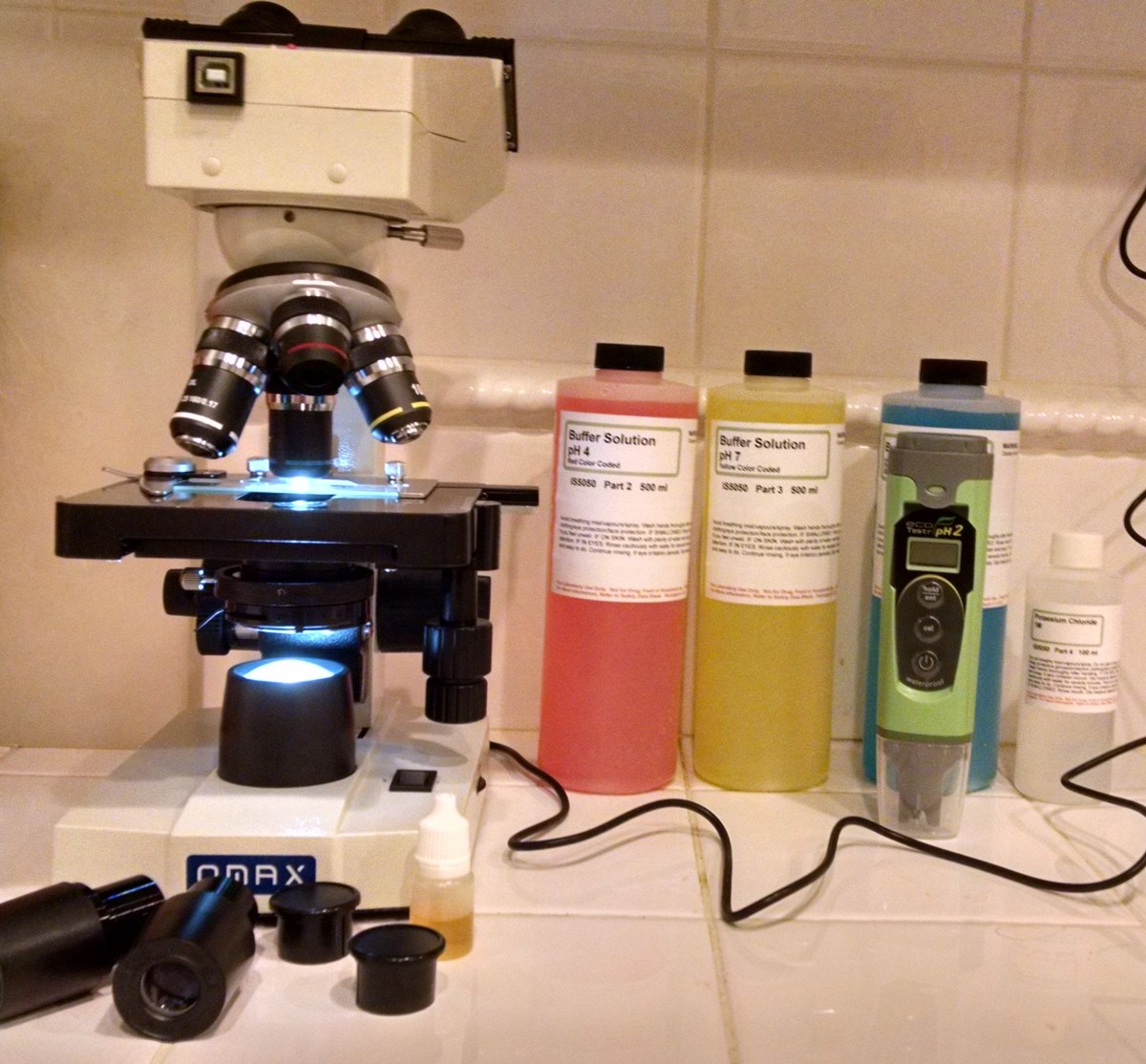
    Bright-field microscope (OMAX CS-MD82ES10) with a 1.3 MP digital camera built in. Combined with a hemocytometer, we will be able to perform cell counts (with the hemocytometer) and standardize our pitching rate. Everything we do needs to be consistent. So we need to start good QA/QC practice early. Speaking of starting early, Alex go in on the microscope action too.

  • Oakton Ecotstr pH meter. Also picked up calibration buffers. This is great for testing yeast viability. Set
    A future microbiologist (?) taking a his first look through a microscope.
    A future microbiologist (?) taking a his first look through a microscope.

    up a small culture, pitch some yeast, monitor how fast the pH drops. The faster the drop, the more viable the yeast culture. This can also be monitored by weighing the starter culture. As CO2 is being evolved, the culture will decrease in weight. Just need a good balance and to remember to weigh the culture immediately after pitching the yeast. A good quality laboratory balance is more expensive and will be purchased at a later date. pH meter will suffice for now.

  • A hemocytometer. Simple, a specialized microscope slide with a grid pattern and reservoirs with a very specific volume. Used for cell counts. Should be delivered on Monday.

Jess is going to go scrounging at the UC Davis surplus store for some general laboratory supplies like a pipettor or two, tips, a pipet aid, some serological pipets, test tubes, and pretty much anything that catches her eye and has a good price on it. If it isn’t at the surplus store, back to Amazon we go! That’s right, we got everything on Amazon. Also, check out MicroscopeNet, this site is where we originally found the microscope we ordered from Amazon. Why Amazon? We already have a Prime account with them. It was easy.

March 13, 2016: Tasting Notes (Amber Ale Two Ways)

This is a continuation of the home brew we started February 28, 2016.

Fermentation was finished by March 3, 2016 and we sampled the beer to obtain the gravity reading. We then dropped the temperature to -1 degree Celsius to facilitate chill haze formation and precipitation on March 4, 2016. We transferred to kegs on March 7, 2016 after Alex went to bed.

We tasted the beer on March 13, 2016 with Jesse, a friend and classmate.

Amber Ale Two Temperature Mash Stats:

Original Gravity: 1.0611

Final Gravity: 1.027

%ABV: 4.46

IBU: 41

Amber Ale Single Temperature Mash Stats:

Original Gravity: 1.0663

Final Gravity: 1.0298

%ABV: 5.12

IBU: 41

Notes:

  • The final gravity it is clear we did not achieve full attenuation (~1.015).
  • It is not surprising the aroma is very malty with very little hop aroma.
  • Color is amber with a hint of red. Two temperature mash may be a bit darker.
  • Beer is cloudy.
  • Both beers live up to their malty aroma in flavor and are sweet. Very little hop bitterness is evident.
  • The two temperature mash is dryer than the one temperature mash, but with the poor attenuation, difficult to distinguish.
  • They are not bad . . . but they aren’t exactly good. Both beers are an excellent example of how bitterness from hops make beers drinkable by balancing the sweetness.
  • Beers are drinkable if done in small amounts. Should not be paired with sweet foods.
  • Single temperature mash is preferred.

Plan of Action:

Jesse talked us out of our panicked throw the kitchen sink at the next brew and got us back to a place of logical thinking.

What we know: poor attenuation, acetaldehyde aromas during fermentation, hint of diacetyl in finished beer. Yeast were pitched directly from the pure pack (no starter) and aeration was done by shaking the fermenter. We used WLP002 (British Ale yeast)

What this points to: Unhappy yeast because of lazy home brewers. Which is frustrating because we were careful in other aspects of our experiment.

What we will do for the next brew:

  • Use a starter culture. ~1.5L for a 19L fermentation.
  • Consider aeration of the wort with an aeration stone and oxygen (we just got a new oxygen tank).
  • We will hold off on any bittering hop additions on the theory that the sweetness is overwhelming the bitterness.
  • We will add more aroma hops at the end of the boil.
  • We will take more frequent gravity measurements to better track fermentation.

February 28, 2016: Amber Ale 2 Ways

It has been a month since we last brewed, and we need to have the new beer ready before the previous batch runs out. Today we have two objectives.

  1. The inaugural brew on our new set-up and test the ice bath as an effective chilled water source for cooling wort.
  2. Test the effect on beer flavor of mashing in at ‘protein-rest’ temperature (~45 degrees Celsius) vs mashing in at conversion temperature (~65  degrees Celsius).

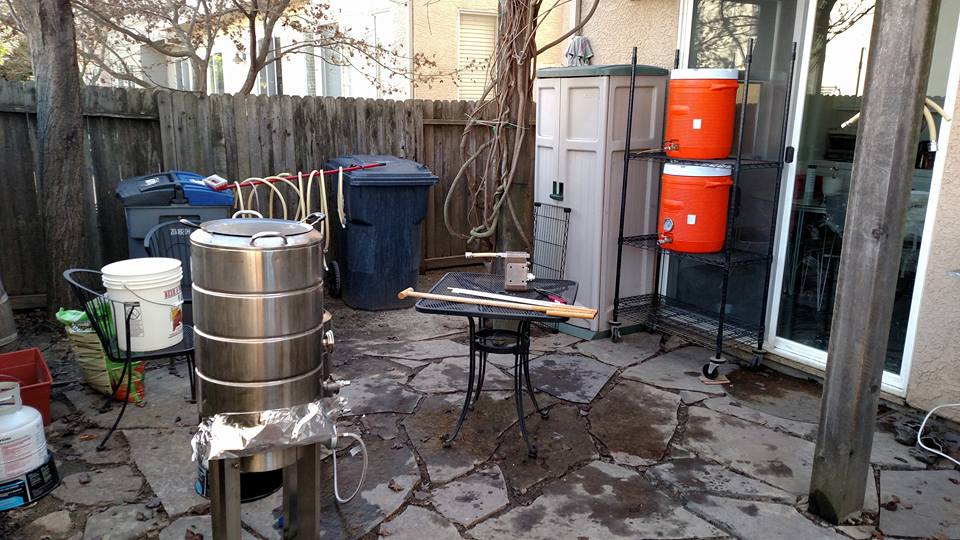
Objective one was completed rather successfully. The system needs further optimization, but overall, the brew day went very smoothly. We discovered we could not fit the brew stand through the gate to the back yard. So we brewed in the driveway. We met more neighbors in a few hours of brewing than we had in an entire month. We were able to cool 4 gallons of wort to 20 degrees Celsius with 5 gallons of water with 10 pounds of ice. The water out from the heat exchanger was added back to the ice bath. By the time the wort was cooled, the ice had melted, but no significant increase to the water temperature was observed. Got to love the isothermal nature of a phase change.

Objective two is to determine if a low temperature ‘protein-rest’ will affect the beer flavor/aroma/mouth feel. We are more concerned with residual B-glucanase activity. Depending on one’s school of thought, this enzyme might have been inactivated in the malting process during kilning, but there is anecdotal evidence that a low temperature rest may result in the break down of B-glucans. With any luck, the result of both experiments will be a drinkable beer. Recipe is listed below, with identical recipes used for each experiment.

Grain Bill: 12 lbs Domestic 2-Row, 1 lb American Pale, 1 lb Crystal 75 L

Hops (Pellets): 0.5 oz Magnum (12.1% AA) 60′, 1 oz Willamette (5.1% AA) 15′

Boil Kettle Volume: 7.5 gallons

Cellar Volume: 4 gallons

Yeast: White Labs PurePitch WLP002 British Ale

Experiment 1 Gravity: 1.0611

Experiment 1 Efficiency: 59%

Experiment 2 Gravity: TBD

Experiment 2 Efficiency: 59.5%

Experiment 1: Mash-in at 48 degrees Celsius and rest for 20 minutes. 2:1 water to grist ratio (w:w). Using the plate heat exchanger, recirculate wort to increase temperature to 64 degrees Celsius and allow conversion to proceed for 30 minutes. Sparge at 72 degrees Celsius. Boil for one hour, whirlpool. Fermentation temperature 20 degrees Celsius.

Experiment 2: Mash-in at 64 degrees Celsius and allow conversion to proceed for 30 minutes. 2:1 water to grist ratio (w:w).  Sparge at 72 degrees Celsius. Boil for one hour, whirlpool. Fermentation temperature 20 degrees Celsius.

Observations: 

  1. Experiment 1 mash-in temperature was a higher than desired, and conversion temperature was lower than target (67 degrees Celsius). To ensure that the only variable was the ‘protein-rest’, experiment 2 conversion temperatures were also modified.
  2. Experiment 2 the fly sparge became a batch sparge due to an airlock in the pump, thus adding another variable to our experiment.
  3. At the end of our sparge, the wort was tested. The reading was ~7 degrees Plato. There is still sugar to be recovered. We could slow down our sparge rate to increase efficiency of sugar recovery. This will also increase the recovery of undesirable compounds (tannins, polyphenols).
  4. We experienced a greater boil off than anticipated based on our experiences from a month ago. It should be noted that we had a much stronger boil an greater evaporation because we were not fighting the wind to keep a constant flame as we had to do our previous brew day.
  5. We used approximately 40 gallons of water to generate 8 gallons of beer.
  6. Fermentation started Monday morning.

Brewing System Upgrades

Jess transferring sweet wort from the mash tun to the boil kettle.

We were frustrated with our set up the last time we brewed. What annoyed us? Clean hoses on the ground, pump on the ground, unstable set up for our gravity sparge system, and a large amount of water used/wasted to cool our wort were just a few of the things that got under our skin while we worked. So the following purchases were made: Blichmann Top Tier Modular Brewing Stand, a centrifugal Chugger Pump, a sparge arm, a whirpool paddle, and other miscellaneous supplies (tubing, quick connectors, gaskets, etc). Our first brew with the new equipment is detailed here.

The new system still needs to be optimized, but overall it was a fantastic brewing experience. We were able to move almost everything off of the ground with the Blichmann stand, and only needed to re-purpose a patio table for our ice bath. The sparge arm is over-sized for our mash tun, so the only option is to get a larger mash tun! The second pump expands our capabilities to easy adjustment of temperature of the wort to allow for rudimentary temperature program mashes and a more effective mash out. The addition of the second pump also allowed us to recirculate to an ice bath to chill our wort. This significantly reduced our water usage and time to cool the wort to fermentation temperature. The whirlpool paddle was another fantastic investment. The result was a well formed trub cone and bright wort.

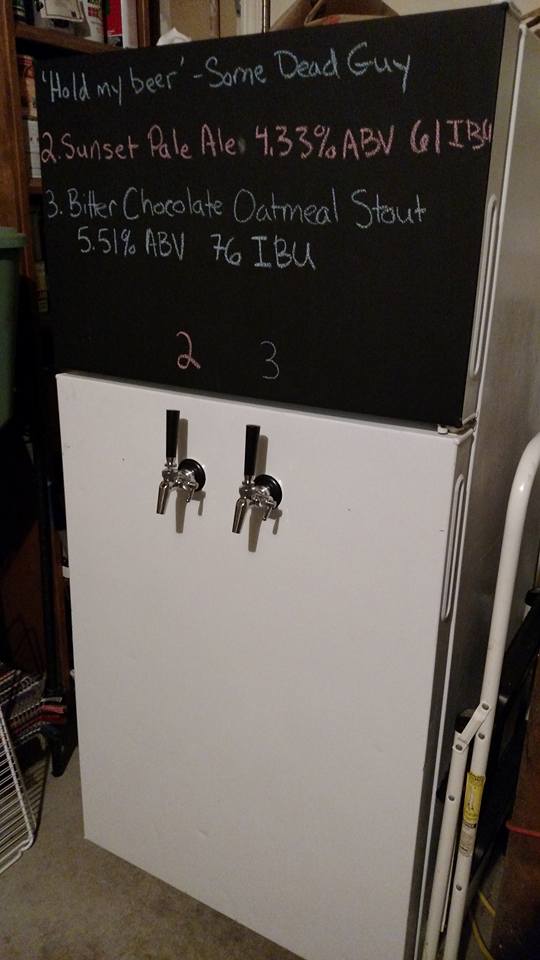
February 18, 2016: Tasting Notes (Sunset Pale Ale, Bitter Chocolate Oatmeal Stout)

First tasting of the beers was 2/13/2016. A second tasting was conducted on 2/18/2016. Of course we drank the beers between tastings! Check out this post for details for brew day and this post for details from kegging day.

Overall, we are pleased with the beers and continue to learn through the process.

Sunset Pale Ale:

2/13/2016 – Golden in appearance with a hint of red. Beer is cloudy. Excellent foam. Aroma was piney hop notes with underlying citrus. Drier finish that is bitter and slight astringent. Lingering bitterness, but not unpleasant. Paired well with food, especially foods with higher fat content (think cheese). Beer was tasted in the early afternoon.

2/18/2016 – Piney hop notes are diminished and there is now an oxidized character to the aroma. The chemical responsible for this character is trans-2-nonenal. Bitterness reduced and astringency increased. Tasting was done early evening.

Off aromas likely from oxidation due to a poor keg purge. There was also a significant amount of head space in the keg after beer was transferred in. Keg was also rinsed with chlorinated water instead of water passed through a charcoal filter. We will see if any aromas that could be attributed to 2,6-dichlorphenol. We also do not know what our water chemistry is at our rental; the chemistry could impact the flavor and stability of the beer, and may impact the pale ale style more significantly than others. It is fun operating in the blind.

Bitter Chocolate Oatmeal Stout:

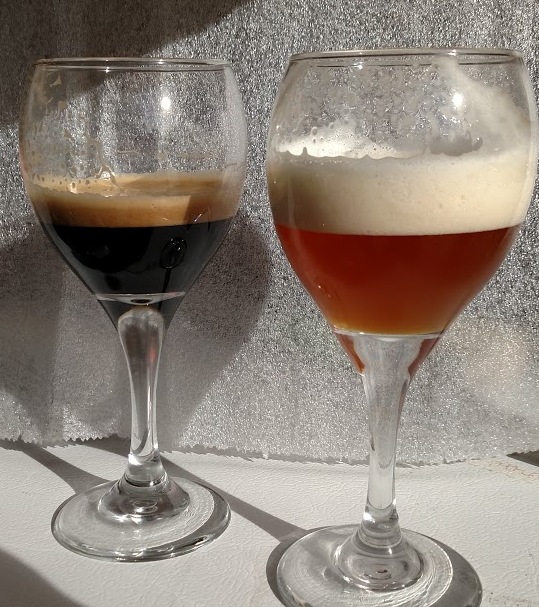
2/13/2016 – Dark brown, almost black in appearance. Excellent foam that was very stable. To borrow from wine tasting, the beer has ‘legs’ and coats the glass after swirling. Aroma contained roasted, chocolate and coffee characteristics. No noticeable hop character. Sweet and bitter characters with a silky mouth feel. Lingering bitterness, but not unpleasant. Beer is drinkable, and is filling. Gravity reading and %ABV need to be redone – it feels like it has and ABV higher than 5.5%. Beer was tasted in the early afternoon.

2/18/2016 – Aroma similar, perhaps with a hint of hop starting to come through. No major differences between tastings.

February 12, 2016: Sunset Pale Ale and Bitter Chocolate Oatmeal Stout

This is a continuation of the home brew we started January 31, 2016.

Fermentation was finished by February 5, 2016. The couple days intended for the diacetyl rest stretched into about four. After sampling the green beer to obtain a gravity reading, we dropped the temperature to 2 degrees Celsius to facilitate chill haze formation and precipitation. After letting the beer rest a couple more days, we plopped Alex in front of the electronic babysitter while we sanitized and carbon dioxide purged our kegs and transferred the beer. All calculations were performed using the tools found on Brewer’s Friend.

Sunset Pale Ale Stats:

Original Gravity: 1.059

Final Gravity: 1.0265

%ABV: 4.33

IBU: 61

Bitter Chocolate Oatmeal Stout

Original Gravity: 1.090

Final Gravity: 1.0484

%ABV: 5.51

IBU: 76

January 31, 2016: Sunset Pale Ale & Stone’s Bitter Chocolate Oatmeal Stout

So, we decided to take a break from chronicling our move to California to start our home brew diary! So if you are reading this and wondering how we are brewing on the road, well, we are not. The chronicles of our westward journey are being provided after the fact. We arrived at our rental in Davis, CA on January 20, 2016. Perhaps we should have altered you, gentle reader, that this paragraph contained spoilers. Ah well. Check out our travel posts. At the minimum, there are some pretty pictures.

On our travels, we just happened to pass by Concord, CA, home of a More Beer! retail store. Of course we stopped. And bought two all grain kits: Sunset Pale Ale (#583) and Stone’s Bitter Chocolate Oatmeal Stout (#800). The goal was to brew the beautiful weekend of January 23rd, but common sense prevailed. We decided to postpone until we got better settled into our new home and Dave reassembled the brew equipment.

What went right

  1. Strike water temperature to achieve the correct mash. Jess took the time to calculate the heat input required to raise the malt to mashing temperature (Q=m*Cp*(T2-T1); where Cp of the mash is estimated at 1680 J/kg*Celsius). This heat input was then used to calculate the temperature the strike water needed to be heated to in order to achieve the desired temperature at mash in.
  2. Alex enjoyed tasting the malted barley and helping wash and sanitize the hoses. As long what is being cleaned isn’t Alex’s face or hands, he is all for it. He was a good brewer’s assistant. Never fear, once the propane burners were lit, he was safely inside.

What went wrong

  1. The weather. A cooler day, the constant breeze illustrated the powers of convection. Throw in the fact that the wind blew out our burners a couple of times, it is no wonder it took so long to heat our liquids.
  2. Shaking the dust off. It was series of little things because we haven’t brewed in a couple of months. Finding the proper hose with the right couplings, a kettle that was leaking due to the gaskets, remembering that the pump needed to be primed. Those small things add up to some serious lost time.
  3. Chocolate nibs are an impressive clogging agent, especially coupled with a plate chiller. This only emphasizes how our process needs to be refined. We will get there. Nothing a little whirlpool action and some filtration won’t solve.
  4. The amount of water we needed to use to chill our wort. We definitely need to improve our water conservation. Or hide our usage from our neighbor. The target is conservation.

Sunset Pale Ale Recipe and Stats

Grain Bill: 8 lbs American Pale, 2 lbs Munich, 0.5 lbs Carastan, 0.5 lbs Carapils

Hops (Pellets): 1 oz Amarillo 8.5% AA 60′, 0.5 oz Northern Brewer 7.0% AA 30′, 0.5 oz Cascade 5.5% AA 10′, 1 oz Amarillo 8.5% AA 5′, 1 oz Tettnanger 4.6% AA dry hop

Yeast: White Labs Pure Pitch WLP001 California Ale

Original Gravity: 1.059

Final Gravity: TBD

Fermentation Temp: 20 Celsius

Observations:

  1. Fermentation started by Monday morning.


Stone’s Bitter Chocolate Oatmeal Stout

Grain Bill: 15 lbs Two Row, 2 lbs Flaked Oats, 1.5 lbs Pale Chocolate Malt, 1 lb Black Patent, 1 lb Roasted Barley, 1 lb Crystal 15 L, 8 oz Carapils

Hops (Pellets): 4 oz Willamette

Additions: 4 oz Cacao Nibs added with 15′ left in boil

Yeast: White Labs PurePitch WLP001 California Ale

Original Gravity: 1.090

Final Gravity: TBD

Fermentation Temp: 20 Celsius

Observations:

  1. After mash was finished, the air bubbles on top of the grain bed were multi-colored which is indicative of a good mash.
  2. A lot of trub at end. Clogged the plate chiller pretty quickly.
  3. This is going to be a dark, dark beer.
  4. Fermentation was going around midday Monday.