Living in Davis

Weather: There is a lovely lack of humidity. So much so that when the dew point creeps above 50 (a low humidity day back east), it feels rather humid in Davis. However, in the summer the temperatures can reach 110 degrees Fahrenheit or so. Even with the lower humidity still hot. A summer or two of that type of heat, we might even start wearing parkas when it gets down to 50 degrees Fahrenheit.

Taxes: 8.25% sales tax in the city of Davis. Coming from Delaware, land of no sales tax (and shell corporations to assist you in money laundering and tax evasion), this was a shock. We rented, so we cannot comment on property taxes. You do get something for your money though. The community park network is extensive, bike trails cross the city, there is yard waste pick up, and the city is neat and tidy. So, we grump a bit when we pay the tax, but we actually see the positive effects the money has to the community.

Roads: With the money one pays in taxes, the gentle weather (think no frost, so no frost heaves), and a bike culture that cuts back on motor vehicle traffic, the assumption would be the roads would be pristine. Alas, they are not. Definitely a step up from what we experienced in Louisiana, but a far cry from the glass smooth roads in Texas (county routes included!). The best part is the manhole covers. It looks like the wrong size collars were installed, so these covers sit significantly above the road level and they city attempted to pave a grade up to the covers. An interesting experience driving over these things in Abby. Oh, and the other drivers. Very indecisive to the point of timid, with a complete lack of understanding of how to use a rotary. Hint, if you are in the rotary, you do not yield to traffic entering the circle.  It could be argued that California has some of the worst drivers in the country.  Not paying attention, not caring about any kind of order, just a big whatever. This may be a reflection of our east coast driving style as well.

Liberal/Conservative: Davis a college town in California. It is a wee bit liberal. This may be a deliberate understatement. Here is a link to the campus newspaper. The town loves regulations. In the park near our rental there are about 100 signs each with a different town ordinance with a summary of what you cannot do. Feels like when Bart joined the Junior Campers and got the book the 10 Do’s and 500 Don’ts of knife safety. Just remember don’t do what Donny Don’t does.

The People: Cordial, turning friendly as soon as one begins to brew beer in the driveway. Being a college town, it is full of college students, who making going anywhere near campus downright dangerous. It is stressful to drive a car near the college. Why? Bicyclists who believe they are permitted to ignore traffic laws, all while they are texting (not a single hand on the handlebars), ear buds in, completely oblivious to the world. UC Davis, please put some serious consideration into establishing a semester long mandatory freshman seminar called ‘Situational awareness: keeping you alive’. And a bicycling safety seminar. Transfer students have to take these seminars as well.

Parks/Community Recreation: An extensive park system with small neighborhood parks tucked along bike trails bordering communities. Lots of large parks for soccer or Quidditch tournaments (remember, it is a college town). We signed Alex up for gymnastics class (Diaper Daredevils, Creative Climbers) through the City of Davis and he absolutely loved it.

Bike Trails/Lanes: Ubiquitous through out the city. A 12-mile scenic loop around Davis and many more paths across Davis. Some challenges are the rough roadways for the bike lanes, and some of the bike trails provide a good challenge in dodging potholes and heaves. Also, yard waste tends to be piled in the bike lane.

What we will miss: Parks, bicycle infrastructure, the produce (farmer’s market is fabulous), restaurants (nothing 5 star, but solidly decent food), simply gorgeous winter and spring weather.

What we won’t miss: Living six feet away from our neighbors, oblivious college students, the summer heat, how expensive everything is.
Magic 8 Ball Says: Reply hazy, try again

It has been a long time between posts. Jess has had her nose deep in the books studying for the Institute of Brewing and Distilling Diploma in Brewing Exams, all while searching for a job. Which means Dave has been busy wrangling Alex, the dogs, and running a household. Alex is getting the itch to travel and is always very excited to see Abby or take a ride in the car. Little does he know, we will soon be on the road again.

AlexAbbyJune
Alex is very happy to pay Abby a visit at the storage facility.

With the UC Davis Extension Master Brewers Program in its penultimate week and Jess still unemployed, the question is ‘what next?’. What we know for sure is that we will take about 2 weeks to travel around California before our lease is up. After that we will pack up our trailer and head to Colorado, where we have a solid lead on a rental.

It is after this point the Magic 8 Ball’s reply gets a little hazy. If Jess finds employment, a routine will be established and we will settle in to that. If Jess is still unemployed, we will take the opportunity to travel. Perhaps up to Banff, down to Washington, Oregon, and then back to Colorado. The future is unwritten, but we at least have an outline.

April 26, 2016: Tasting Notes – Amber Ales, Belgian Blond, and Vanilla Bourbon Imperial Porter

Wanted to provide updated tasting notes on the dry-hopped Amber Ales, Amber Ale version 2, Belgian Blond, and the Vanilla Bourbon Imperial Porter (VBIP). The Belgian Blond and VBIP were initially tasted during the height of allergy season and the only thing that could be determined with any certainty was beer was being consumed. The dry-hopped Amber Ale was first tasted in mid-March prior to dry hopping. Under attenuated, under hopped, these beers were almost undrinkable. We combined the kegs and dry-hopped with 2 oz of Amarillo pellets. Finally, the Amber Ale version 2, brew day was discussed here. In a perfect world the tasting notes would have been posted two weeks ago, but clarity issues existed.

VBIP: %ABV – 9.8, IBU – data not captured

Aromas of roasted coffee, dark chocolate, and vanilla. Mouth feel is creamy. Roasted flavors with hint of vanilla and bourbon. No alcohol burn despite ABV.

Belgian Blond: %ABV – 4.9, IBU – 10

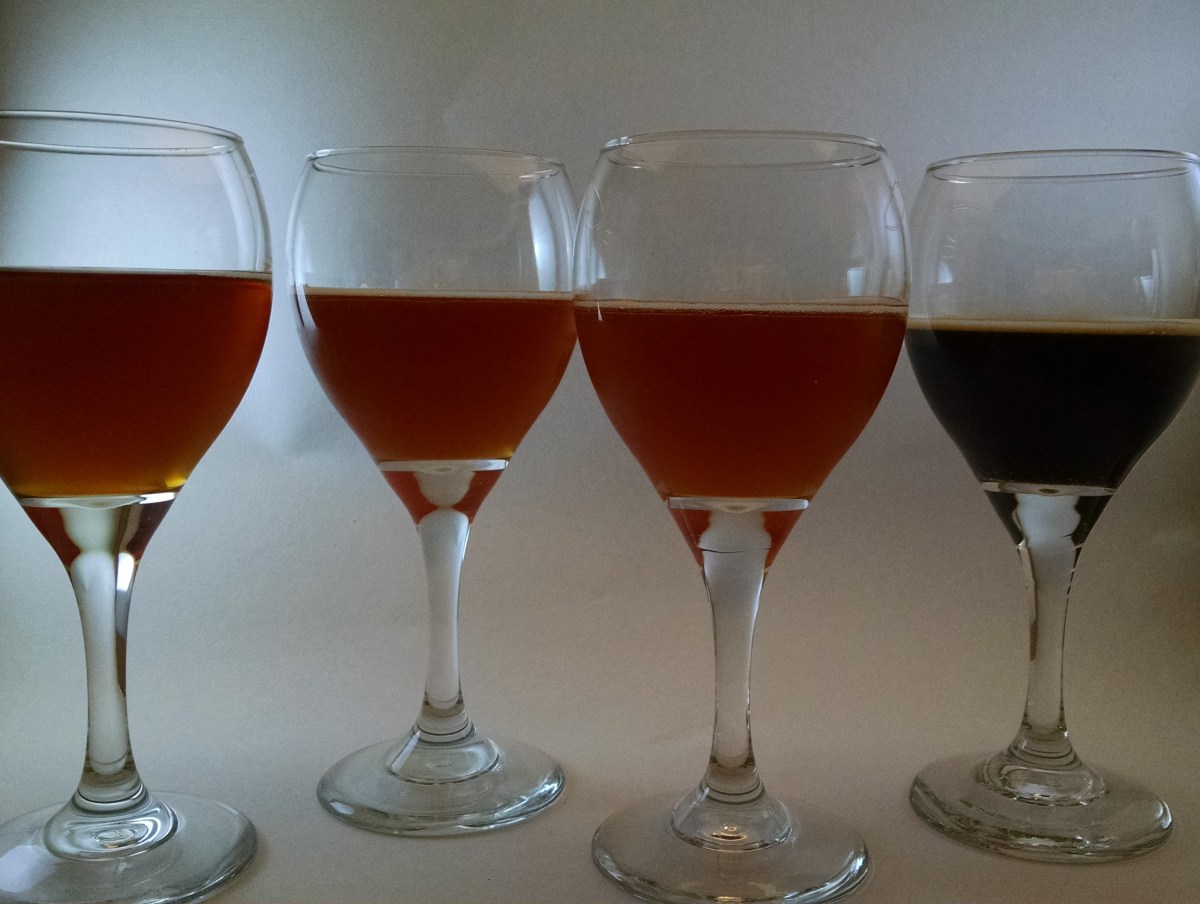
Aroma is phenolic, reminiscent of cloves. Flavor is dry, slightly astringent, with phenol character. Color is darker than expected, and is very similar to the amber ale in color.

Ambersv2
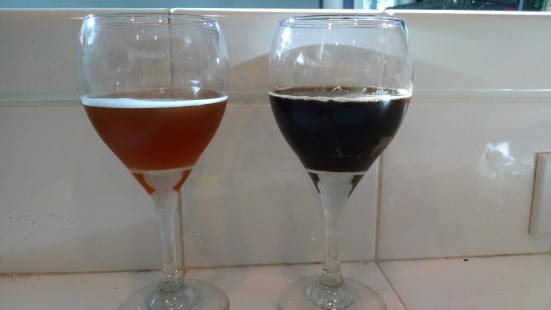
From left to right: dry-hopped amber ale; amber ale version 2.0

Dry hopped Amber Ale Combination: %ABV – ~4.79, IBU – 41

Aroma is citrus, with orange being prevalent, and malty. Sweet, but not as cloying as it was prior to dry hopping.

Amber Ale, version 2: % ABV – 6.3, IBU – 100

Aroma is citrus and malt. Flavor is sweet, with lingering bitterness that is not unpleasant. Some chill haze. Tasting notes were delayed due to microbiological haze (yeast). During transfer to the keg, some yeast was siphoned off from the secondary fermenter. Took a couple weeks for yeast to settle and to be purged from the fermenter (poured and dumped pints until clarity improved). Remaining haze is chill haze as concluded from the observation that the beer becomes clear as its temperature increases. We are pleased with this beer.

Yeast responsible for microbiological haze of amber ale, version 2.0

Alex and Abby – A history

Alex and Abby met for the first time when Alex was just shy of three months old. It was not love at first sight. Alex was tired and cranky and didn’t seem to appreciate the test drive. But good parents that we are, we overrode Alex’s objections and purchased Abby.

August 2014: Alex’s first trip in Abby was an overnight shakedown run to Pequea Creek Campground in Pennsylvania. It was on this run that future thoughts for organization started to present themselves. But nothing too disastrous and we were only an hour away from home.

Ommegang
Jess enjoying a beer, back during the days Alex would sleep at a bar.

October 2014: Alex and Abby had more time to bond on their next trip to Cooperstown, NY area over Columbus Day weekend. We dragged Alex not to the Baseball Hall of Fame, but to Brewery Ommegang. That’s just how we parent. We were fortunate because Alex was still at a stage where he slept – a lot. And wasn’t super mobile so he perfectly content to hang out in his car seat at the table while we ate and chatted. We stayed at Beaver Spring Lake Campground, which had full hook ups. This was very fortuitous because the overnight lows were high 20s. No water lines froze despite our lack of an arctic package. Alex seemed to enjoy himself on this trip and it was deemed rather successful.

Alex enjoying some tummy time outside on the dinette cushions.
Alex snuggled up in his Storchenwiege carrier.

Novermber 2014: Alex took his first trip to Cape Henlopen State Park. This is a beautiful campground area, with some spots very nicely shaded. Being late in the season, the campground was sparsely populated, save some tent campers who were competing in the ‘Skate the Cape’ event weekend. Looked like a fun event; everyone that we interacted with was extremely nice. A drawback at Cape Henlope is the park staff don’t want RVs parking off of the pavement; there are only a few spots that don’t resemble parallel parking. It would be nice if one could be trusted to use their own judgement and park on the hard pack sand, but I am sure experience has taught the staff that most people overestimate their or their vehicle’s abilities. Review the park map and choose wisely. While there are water hook ups, some of the spigots are at least 50′ away from the spot they are assigned to service; pack two sanitary water hoses just in case.

Alex_Hammock
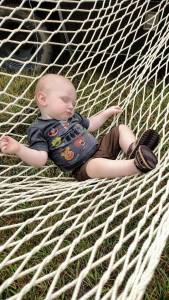
Alex taking a nap in the RV campground at Firefly. Resting up for a big day of concerts and people watching.

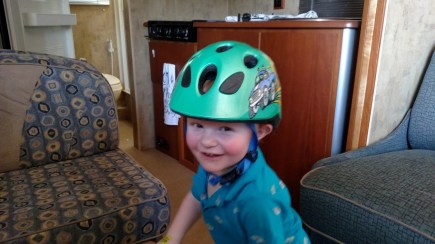
June 2015: 2015 started out relatively quiet with a trip to Cape Henlopen and the Outer Banks as a quick weekend shake down runs ahead of a busy summer travel schedule. After that the travel season became very hectic. First, was our trip to the Firefly Music Festival in Dover, DE the weekend of June 18 – 21. We had been debating on going, but when they announced Paul McCartney was headlining, we decided to go for it. Alex seemed to have a really fun time; we introduced him to the WeeRide which he loved. He had a strong dislike for his bike helmet initially, but once he made the connection between the helmet and going for a bike ride, all was okay. Alex enjoyed snoozing in the hammock and got to “see” Paul McCartney in concert. Never fear, he had ear protection on whenever we were on the concert grounds.

IMG_20150705_195353640
Alex enjoying dirt along the snake river in Wyoming.

June/July 2015Less than a week after we returned from Firefly, Abby spirited all of us (including the dogs) off on a 3 week western adventure. This trip started with failed turbo resonator, but there were no more mechanical failures on the trip. Alex had a great time playing in dirt and “driving” the RV.

Alex enjoying Mama's biscuits and gravy so much he is using two spoon.
Alex enjoying Mama’s biscuits and gravy so much he is using two spoon.

September 2015: Abby took Alex on his first trip out of the country! We drove up to Saint-Alphonse-Rodriguez, in Quebec. It was a fun trip. We were only a little bit nervous at the border crossings because Alex’s favorite phrase at this time was ‘uh oh’. We didn’t think it would be wise to answer the border guard’s question with ‘uh oh’.


October 2015:
Just when Alex and Abby were going to have to say good-bye to each other for a few months, we decided to throw two October trips into the mix. The first was over Columbus Day weekend to the Mansfield area of Pennsylvania. Dave rode his motorcycle up and Jess drove the RV. Alex and the dogs got a bonus visit to the farm to visit Mimi and Grandpa. We stayed at Tanglewood Campground which was very family friendly. Costume parade for the kids and what we heard was a very well done haunted trail ride.

Tanglewood
Morning at Tanglewood Campground.


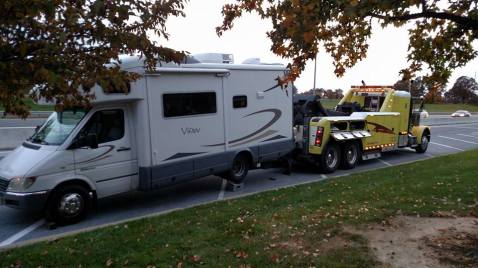
We decided to take a trip to visit all the remaining Northeast states before we moved west. So Alex and Abby hit the road together again to Acadia National Park in Maine. This was the most dog-friendly park we have visited where dogs are allowed on most trails. Our creature triple feature had a great time. Abby was challenged with no hook-ups and short, cloudy days prevented the solar panels from recharging the batteries. We needed to run the generator to charge the batteries. Except we overestimated our propane levels and couldn’t find anywhere to fill up since it was the end of the season and most places had closed down. To add to the challenge, the coach batteries weren’t recharging from the engine. Thus, a very delicate game of cat and mouse was played between propane and battery levels. This trip happened to be the trip that the transmission failed; while Abby didn’t see Alex home to the door, she did arrange a ride for him in a big rig.

Abby being towed from the EZ-Pass administration building parking lot.

December 2015/January 2016: And we can’t forget the cross-country move! Alex and Abby had lots of quality time together as we meandered across the South and up the Pacific Coast Highway to Davis, CA. Check out our detailed blog posts chronicling this journey. There are many more than the one linked, check out the archives or the category ‘Travel Diary: 2016 DE to CA’.

One of our greatest concerns with all the traveling we do is making sure Alex is having fun. We can’t know for sure, but he always gets excited when he sees Abby and wants to climb aboard. All said and done, we let this picture speak volumes.

Alex the traveling man as Abby moves him down the road.

March 26, 2016: Amber Ale v. 2.0

Back to beer! After reliving Abby’s (the RV) mechanical breakdown issues in couple of posts we decided that we needed a drink. So it seemed logical to post about our Amber Ale, version 2.0. The grain bill on this recipe is the same as what our previous amber ale brews, with increased hops, single temperature mash, and a new yeast strain.

Stats:

  • Starting gravity: 1.055
  • Final gravity: 1.007
  • Approximate %ABV: 6.3
  • Approximate IBUs: 100

Grain bill:

  • All grains Great Western Malting and purchased through More Beer.
  • 10 lbs 2 row domestic (#46080)
  • 1 lb 2 row pale (#45958)
  • 1 lb crystal 75L (#45744)

Hops (Pellet):

  • 2 oz Magnum 12.4% alpha acids (#45958)
  • 2 oz Amarillo 8.2% alpha acids (#46117)
  • 2 oz Cascade 6.8% alpha acids (#46014)

Yeast:

  • Wyeast 1450 Denny’s Favorite 50 (#0742020, mfg 1/20/2016)

Water:

  • pH of water was determined to be 8.2; 57 g of gypsum was added to 47L of water in the hot liquor tank which decreased the pH to 7.7

Procedure: Yeast was propagated in 1 L of media (0.5 c DME in 1L/~1qt water, boiled) in a 3L flask with stir bar that had been sanitized with boiling water. Media was inoculated from Wyeast Smack Pack. Propagation culture was grown at room temperature with stirring for 72 hours and was then transferred to a 4 degree Celsius for 24 hours.

Strike temperature was 74 degrees Celsius. A ~2:1 water to grist ratio was achieved with 11.5 liters of water. Mash in temperature was 63.3 degrees Celsius, 2 degrees below target. Mash out was conducted at 76 degrees Celsius. Mash was fly sparged at 79 degree Celsius until the volume of sweet wort in the boil kettle was approximately 8 gallons. Hydrometer reading of the last wort remaining in the mash tun was 5.0 Brix.

Sweet wort was brought to a vigorous boil. Magnum hops were added at 60 minutes, Amarillo hops added at 5 minutes with 1/2 tablet Whirlfloc, and the Cascade hops we added at heat off. After the trub settled, the hopped wort was cooled to 20 degrees Celsius with a counter-flow plate chiller with a recirculating ice/water slurry. Cooled wort was aerated with 90 seconds of oxygen through a sinter. Liquid was decanted off the top of the settle yeast, and the yeast slurry was pitched into the Speidel fermenter and left to ferment at room temperature.

Primary fermentation was complete after 72 hours and the diacetyl rest was allowed to proceed for 24 hours. The green beer was then transferred to secondary fermenter and allowed to stand at room temperature for 72 hours. The fermenter was then transferred to -1 degree Celsius for 6 days prior to kegging.

The amber ale was transferred to 1/3 keg and pressurized to 30 psi. The keg was placed on its side and rolled for approximately 2 minutes. The keg was then pressurized to 30 psi again and rolled for 5 minutes. The keg was pressurized once more to 30 psi and placed in the kegerator. We hope to have tasting notes in the next 24 to 48 hours.

Comments:

  • We whirlpooled twice. We did not double check the position of the boil kettle outlet, and had to turn the kettle to prevent the hoses from pinching. In turning the kettle, we disturbed the trub and had to repeat the whirlpool. This may result in a DMS problem in our beer.
  • Fermentation was conducted at room temperature because the incubator was occupied by the Belgian Blonde and Vanilla Bourbon Imperial Porter being cold crashed.
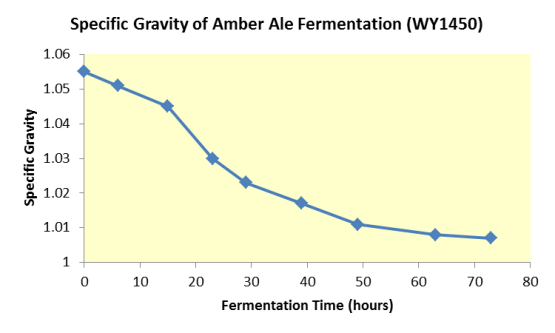
  • Vigorous fermentation was observed, complete attenuation reached in 72 hours. We did a much better job collecting well spaced hydrometer readings to determine gravity. For our next batch we will also take pH readings to track the fermentation progress. More DATA!

    Fermentation_AmberAle2
    Graph of Amber Ale, version 2.0 specific gravity over the course of fermentation.
  • We discovered that our freezer became unplugged during the cold crash. We don’t know when, the fermenter did feel cold to the touch.
  • IBU values are higher than anticipated. Unfortunately, we do not have the equipment to perform an accurate assessment. We will have to determine during tasting if we decrease our hop additions.
  • The microscope is a fun tool. The picture below is yeast at 6 hours post pitching. The yeast looked happy. Happy yeast makes good beer.
WY1450_20160326
Yeast from our Amber Ale version 2.0, 6 hours post pitching.

Transmission Failure: October 2015

Abby being towed from the EZ-Pass administration building parking lot.
Abby being towed from the EZ-Pass administration building parking lot 15 miles from home after a trip to Acadia National Park.

Symptoms:

  • Pressure applied to gas pedal, engine revved, speed did not increase.
  • Shifting into various gears and stepping on the gas resulted in more engine revving, and at best, a few feet of movement.
  • During a test drive at the dealership, Abby threw a fault code that the technicians had never seen before and required a call to Mercedes headquarters (yup, Germany) for correct diagnosis.

Fault Codes:

  • There were fault codes, we just don’t remember them. We might have written them down somewhere. Time will only tell if we find them.

Problem: We initially hoped that a failed seal leading from the transmission case to the control board had caused a temporary short. Dave did some parking lot diagnosis, and thought that a failed seal might be causing the electrical connection to the computer to short out.  The connection was cleaned, Abby drove for about 30 feet and then died again.

We now know what an emergency, after-hours tow of an RV costs.

We also now know what a scheduled, normal business hours tow of an RV costs.

Solution 1: We had Abby towed to a friend’s nearby shop, where Dave hoped to work on it some more the next day.  The next thing to check was the transmission computer.  Dave followed the wiring back inside the cab and pulled the transmission computer.  As suspected, transmission fluid had wicked up the wires about 3 feet, and into the transmission computer. Dave carefully opened the computer case, cleaned and dried everything off, reassembled it, and reinstalled the computer.  Abby was placed in ‘Drive’ rolled about 30 feet, and quit again.  So much for that solution.

Solution 2: Abby was towed to Carman Dodge for professional diagnosis and repair. What was projected to take a week took a month. Initially, the error code that was being thrown was easy to diagnose.  The technician thought it was a bad shift solenoid on the valve body.  This was going to cost a fair chunk of change, but not the end of the world.  A new valve body was ordered and installed.  Abby started up and ran fine.  She made it about 3 miles into the mechanic’s test drive, and that’s when something gave up deep inside the transmission.

The error code Abby threw was something the dealership had never seen before and they had to call the mother-ship in Germany.  The new code meant ‘install a new transmission’.  Sigh.  The dealership called with the bad news.  After some pointed questions about having to pay for diagnosis time, a new valve body, AND now a new transmission, things were getting a bit testy. (It should be noted that it was not Jess conducting this interrogation, but Dave. The good cop was having a bad day.)  The service manager at Carman admitted that they misdiagnosed it, and they would eat the cost of the diagnosis and the valve body.  We have to give them a lot of credit.  In a day and age where dealerships are known for ripping people off, they did a stand up thing, and made it right.  We still weren’t happy about having to buy a new transmission at 65,000 miles, but Abby got one.

We purchased a Good Sam membership and towing coverage.

Repair Tips/Comments

  • Mercedes recommends servicing the transmission every 90,000 miles. Abby had 65,000 miles on her. Reports from the owner’s group is that more transmissions have failed in Sprinter based RVs than probably should.  RVs are often loaded to their maximum limits, and may also be tasked with towing, too. The recommendation is to service the transmission every 30,000 miles or so. Especially if the vehicle has been used to tow.
  • The repairs Dave attempted are not for the weekend mechanic who is used to changing a vehicle’s oil and maybe air filter. Only recommended for a seasoned mechanic. The transmission fix – just send to a professional.
  • Abby’s stay at the mechanic was not completely unfortunate. We were trying to sell the house at that time, so it was good she was parked somewhere safe during showings. Apparently a RV parked in your driveway is not a selling feature. The month long absence completely threw off our packing schedule and contributed to move out chaos.

Turbo Resonator Failure: June 2015

Dave working on the turbo resonator.

Symptoms:

  • Acceleration was not smooth, check engine light came on. Symptoms disappeared on restart of engine.
  • During hill climbs, acceleration decreased dramatically, symptoms disappeared for time after engine restart. Each successive restart resulted in a shorter and shorter time before symptoms represented. Check engine light came on after multiple restarts.

Fault Codes:

  • OBD II P0121: Throttle/Pedal Position Sensor/Switch ‘A’ Circuit Range/Performance Problem
  • OBDII P0299: Engine Turbo-Supercharger Boost
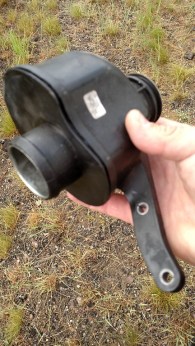
The split turbo resonator. That seam should not have that gap.

Problem: The turbo resonator is made of plastic and the seam failed. This is a known failure point according to multiple forums. Mercedes has been through three revisions of this part in plastic and it keeps failing.

Solution: Previous owner had the turbo resonator replaced once by Mercedes dealer and they put in another plastic version. Previous owner decided to purchase an all aluminium replacement part and it transferred to us when we purchased Abby. Repair was simple enough, complicated by rain and being parked in an emergency pull-off area along I-76W. Requires low clearance 1/4″ socket (which we did not have). We limped into Somerset, PA with an escort by a Herring Motor Company tow truck (fortuitously helping an automobile with issues in our emergency pull off), to purchase a $9 socket wrench to properly execute the repair. Dave performed all mechanical repairs. Jess served as chief child and dog wrangler and did not bake cookies while waiting for the repairs to be completed.

Repair Tips/Comments:

  • Still have the plastic turbo resonator in? Just order the all metal version and replace it before it fails on the road. Repairs are always easier on a nice day, parked in your driveway/workshop, without traffic flying by at 70+ mph. An inexpensive repair (if you do it yourself, several hundred at a dealership) that will save you time and headache on the road.
  • This is a repair you can do yourself if you are comfortable doing basic maintenance work on your vehicle. It is two hose clamps. That is it. The working space is tight, which adds to the challenge.
  • Have your outdoor rug easily accessible. It doubles well as a work pad
  • The metal part does whistle. So don’t panic. It may be noisier, but it won’t leave you stranded on the side of the road.

March 31, 2016: Tasting Notes – Belgian Blond and Vanilla Bourbon Imperial Porter

BelgianBlondVBIP
Belgian Blond (left) and Vanilla Bourbon Imperial Porter (right).

These are the tasting notes from our Belgian Blond (BB) and Vanilla Bourbon Imperial Porter (VBIP) extract/grain combination brew days. It should be noted that with this tasting Jess is suffering from allergy related stuffiness and could only be confident she drank beer; we are relying on Dave’s impressions since he is the less allergy-struck party. We will re-taste when our sinuses clear and most things no longer taste like well-chewed paper.

Belgian Blond

  • Original gravity: 1.043
  • Final gravity: 1.006
  • % ABV: 4.9
  • IBU: ~10

Visual Impressions: BB was darker than we were expecting (straw). Chill haze. Initial pour had good head, but foam stability is poor.

Aroma Impressions: Smelled strongly of cloves. No hop character. This was consistent with the aromas noted during fermentation.

Flavor Impressions: Dry. No hope bitterness. Phenolic after taste.

Vanilla Bourbon Imperial Porter

  • Original gravity: 1.083
  • Final gravity: 1.010
  • % ABV: 9.8
  • IBU: Data for calculations not captured

Visual Impressions: VBIP is dark. Initial pour had some head, but foam stability poor.

Aroma Impressions: Vanilla. Bourbon. Hint of leather (phenolic). No prominent hop aroma.

Flavor Impressions: Vanilla and bourbon present, but not overwhelming. Bitter after taste, but not harsh. Dry. Creamy mouth feel.

Notes

  • We forgot again and did all our fermenter and keg cleaning with water straight from the tap. The chlorination could be why the phenolic aroma is present in the VBIP and enhancing the natural phenolic character (due to yeast strain) of the BB.
  • The starter culture improved our attenuation. Forced fermentation wort studies will be conducted on wort batches in the future to determine final attenuation.
  • DATA! Still need pipetters for performing accurate dilutions, but once these are obtained, Jess is looking forward to constructing yeast growth curves to go along with the specific gravity curves. This is a late developing thought, but the pH of the fermentation can also be tracked, logged, and graphed.

California Move: Trip Summary and Statistics

OverallTripMap
Cross country route to Davis, CA. It wasn’t what one would call direct.

Total mileage: 4596

Gallons diesel: ~315

Average MPG: ~14.6

Well, it only took us two months to get our travel diary entries into blog form. Looking back, it was a bit of a rainbows and roses view of the trip. This is not saying that it wasn’t all storm clouds, but 2 adults, a toddler, and three dogs all sharing 150 feet square feet for a month can wear on all parties. All creatures seemed to have less tolerance for everything. It was nice to get out of Abby and into something a little bit more generously sized. So we survived our journey, and a wonderful time (with a few clouds thrown in here and there).

We made some improvements over our last westward trip (June/July 2015 – hope to get some summary posts up regarding that trip soon).

  • The main improvement being that we added rest days. We stopped, relaxed, and didn’t have to worry about jumping into Abby and heading to the next destination.
  • We coordinated our food/fuel stops. We filled Abby up just before we arrived the night’s campground and filled up when we stopped for lunch. This allowed us to save time in the morning when we had a long day and needed to get on the road. The single stop during the day reduced our total travel time.
  • It was really nice to visit family and friends during the course of the trip.

There are still opportunities for improvement.

  • Our travel days were not leisurely. We had a schedule to keep, so if we passed something of interest on the road, we couldn’t necessarily stop and check it out. If we really enjoyed a place, like Big Bend, and wanted to stay longer, it just wasn’t feasible.
  • This was a dual purpose trip. We were moving across country so that meant extra stuff came with us that normally wouldn’t have been on this trip. So much extra stuff.
  • We also learned that setting the cruise control while towing is not the best option if there are hills/mountains involved (lets just say positive grades). It taxes the engine and transmission and completely destroys gas mileage. We learned that lesson pretty quick.
  • Covering 1200 miles in the first three days (~1/4 of the total mileage in ~1/9 trip time) was brutal.

So what was Abby’s state at the end of this? Poor girl was filthy, inside and out, despite our best efforts regarding the inside. Abby smelled of laundry, wet shoes, wet dog, and dog urine (thank you Buster for deciding your bed was an appropriate place to pee when you didn’t want to go out in the rain). Abby’s exterior was covered with Amish country road apples (horse crap), road salt, grease, dirt, and sea spray. A little bit of elbow grease and a truck wash cleaned Abby right up. And freed of the trailer, Abby was down right sporty in handling and acceleration.

March 20, 2016: Belgian Blond

This is another extract/grain kit. Not because we were short on time, but because we didn’t think far enough in advance to order our grains from More Beer for delivery by Saturday. The local home brew stores we are familiar with did not have the grains we wanted for another attempt at an amber ale. So we settled for the Belgian Blond kit from The Brewmeister.

Fermentation_BelgianBlonde
Graph of Belgian Blond wort specific gravity during fermentation.

The milled grains were steeped at 72 degrees Celsius for 20 minutes, with the steep temperature decreasing to 70 degrees Celsius over the time course. The liquid malt extract (LME) was added to the water and mixed to ensure the mix was homogeneous. Initial volume was approximately 8 gallons. The sweet wort was brought to a vigorous boil for 60 minutes. Hop additions were made at 45 and 5 minutes (1 oz each addition). Hopped wort was cooled to 20 degrees Celsius and transferred to a Speidel 30L HDPE fermenter and aerated for 90 seconds with oxygen. The wort was inoculated with 1 L of 36 hour starter culture of WLP500. Original gravity was 1.043. Gravity readings were taken at 8 to 24 hour intervals over the course of fermentation.

What went well?

  • The stand proves its worth every time we brew on it.

    800X bright field microscope image of WLP500 starter culture.
    800X bright field microscope image of WLP500 starter culture.
  • Captured more relevant data.
  • The microscope purchase was well worth it. This yeast strain had an extended lag phase and sampling the starter culture 8 hours after inoculation showed actively budding cells.

Areas for improvement

  • Data capture. Still need to get a form together.
  • Rather sporadic time intervals of gravity readings and the long gap between pitching and the next reading.
  • Water usage. Estimate of 4 gallons of water used for every gallon of finished beer. We will keep looking for ways to decrease our water consumption.

Recipe:

  • 6.6 lbs Briess Pilsner LME
  • 1 lb Pilsner malt
  • 1 lb Munich malt
  • 2 oz Styrian Goldings (1.4% alpha acids), split (45 minutes, 5 minutes)
  • 1/2 tablet whirlfoc (5 minutes)
  • Yeast: WLP500 (Monastery Ale, Lot #: 1023586)