We brewed our Imperial Amber Ale October 29, hoping to replicate the success of our August brew. The clarity was decreased slightly (okay, it is still a pretty clear beer, just not so clear that you can read a car’s license plate through it). Changes between the brews were
Cascade went from whole hops to pellets. We wanted pellets originally, but our local home brew shop did not have pellets in stock when we brewed in August.
Went from 1/2 tablet Whirlfloc to 1 tablet. This may be the cause of our clarity issue, since too much Whirlfloc can be a bad thing in regard to clarity.
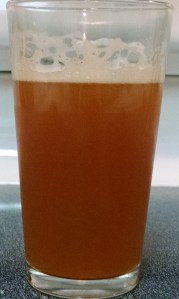
Alex’s Imperial Amber on the left and the Bourbon Vanilla Imperial Porter on the right.
We are still very happy with Alex’s Imperial Amber. Hop aroma contributes a floral/citrus character; there is also malt and a dried cherry component to the aroma profile. Due to a over vigorous boil, our yield was slightly reduced, so all we can do is enjoy a home brew and make some more.
If we manage to brew this for a third time and achieve similar results, a good beer brewing streak will be established.
We brewed our base Imperial Porter recipe October 22 hemming and hawing over the addition of vanilla and bourbon. We decided to go for it and added vanilla beans at secondary fermentation and bourbon at packaging (~68 mL bourbon/gallon beer).
We did our initial tasting while we were both suffering head colds and were disappointed in how it turned out. Not much roasted character, hardly a hint of vanilla, and just tasted thin. Then our sinuses cleared, and what a difference a clear nose makes.
The roast character was immediately apparent, the mouth feel was fuller. The vanilla was more present, but there is room to add more. The bourbon mellowed nicely after a week with the beer; next time we brew this beer we want to impart bourbon character without adding bourbon or aging in a barrel (bourbon barrel pieces in secondary?).
The porter had a third taster. The HVAC guy saw our brewing equipment in the basement and got to jawing with Dave. Turns out the HVAC guy loves porters and was more than happy to taste test ours. He likes a little more vanilla character (we concur), but overall enjoyed the beer.
We are very happy beer drinkers with both of these beers.
Wyeast 1272 American Ale II (#1001271, mfg 9/27/2016)
Stats:
Starting gravity: 1.070
Brewhouse efficiency: 73%
Final gravity: 1.002
Approximate %ABV: 8.798
Approximate IBUs: 108.1 (Rager)/109.5 (Tinseth)/11.4(Daniels) as determined using the Hopsteiner and Homebrewing.com IBU calculators.
Procedure Highlights: We transferred our strike water to the mash tun using a silicon hose and lost less heat than we had anticipated. The end result was we mashed in at 73 degrees Celsius. We quickly added ice and brought the temperature down to 67 degrees Celsius, which was lower than our target of 69 degrees Celsius.
The wort was oxygenated for 45 seconds prior to pitching the yeast slurry. The yeast starter culture was cold crashed after approximately 18 hours of growth in 10% DME (w/v) media. The cold crash was to arrest metabolism and settle the yeast so excess liquid could be decanted.
Fermentation profile for our Amber Ale. Such happy yeast!
After a week in the primary fermenter (Spiedel), the beer was transferred to a metal conical bottom fermenter and kept at approximately 19 degrees Celsius (ambient temperature) for 48 hours. The beer was sampled and no acetaldehyde character was detected. The fermenter was then transferred to -2 degrees Celsius freezer for the cold crash.
Comments:
A vigorous boil resulted in a lower volume of sweet wort.
Our efficiency was similar to the last time we brewed our Amber Ale.
The lower volume of sweet wort resulted in a slightly higher original gravity (1.070 vs 1.065). This resulted in an approximately 0.7% increase in ABV.
We have returned to our Vanilla Bourbon Imperial Porter recipe that we enjoyed in California. We are looking forward to this beer and hope we aren’t disappointed.
Grain bill:
All grains were purchased at Hops and Berries in Fort Collins, CO.
12 lbs 2 row domestic
2.75 lbs Munich 15L
1.5 lbs Brown Malt
1.5 lbs Chocolate Malt
1 lb Crystal 120L
1 lb Crystal 60L
Hops (Pellet):
0.375 oz Northern Brewer 7.3% alpha acids
0.875 oz Chinook 11.9% alpha acids
Yeast:
Wyeast 1272 American Ale II (#1005271, mfg 9/27/2016)
Stats:
Starting gravity: 1.080
Brewhouse efficiency: 85%
Final gravity: 1.015
Approximate %ABV: 8.316
Approximate IBUs: 39 (Rager)/27 (Tinseth)/38(Daniels) as determined using the Hopsteiner and Homebrewing.com IBU calculators.
Water:
The city of Loveland has great water. We will pass the water through an activated charcoal filter to remove any chlorine that may be present.
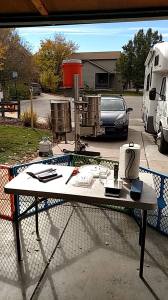
Brew day set up!
Procedure: Yeast was propagated in 1.2 L of media (1:10 DME:water) in a 2L flask with stir bar that had been sanitized with Star-San. Media was inoculated from Wyeast Smack Pack. Propagation culture was grown at room temperature with stirring for 16 hours.
Strike temperature was 78 degrees Celsius. A ~2.5:1 water to grist ratio (L:kg) was achieved with 22 liters of water. Mash in temperature was 69 degrees Celsius, 1 degree above target. The mash was fly sparged at 74 degree Celsius until the volume of sweet wort in the boil kettle was approximately 10 gallons. Hydrometer reading of the last wort remaining in the mash tun was 4.0 Brix.
Sweet wort was brought to a vigorous boil and boiled for 90 minutes. All hop addition times are listed as time remaining in the boil. Chinook – 60 minutes; Northern brewer, 1 tablet Whirlfloc – 10 minutes. After whirlpooling and allowing the trub to settle, the hopped wort was cooled to 19 degrees Celsius with a counter-flow plate chiller with a recirculating ice/water slurry. The hopped wort was oxygenated. The yeast starter culture was immediately pitched into hopped wort. The fermenter was placed in an incubator with temperature monitoring only, until 22 degrees Celsius was reached. Temperature control was then set in cooling mode, with 20 degrees Celsius being the maximum temperature.
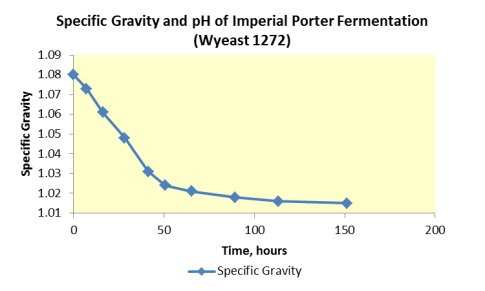
Fermentation profile of some very happy yeast.
After a week in the primary fermenter (Spiedel), the beer was transferred to a metal conical bottom fermenter with 5 oz vanilla beans, split and chopped. During fermentation, diacetyl character was noted at time points 28 to 51 hours, but was not present afterwards. The fermenter was kept at ambient temperature (19 Celsius) and was then cold crashed. The beer will be transferred to a keg, where bourbon will be added.
Comments:
The shorter propagation time resulted in a beautiful profile. Happy, healthy yeast make great beers! We are definitely staying with a shorter propagation time.
We are now tracking temperature. More data!
Our brewhouse efficiency was a whopping 85%. Looking forward to trying to replicate this efficiency.
Our boil was not as vigorous as desired, resulting in a larger fermentation volume. We expect our original gravity would have been higher with a more vigorous boil (more evaporation, less volume, more concentrated sugars).
We cold crashed our White Stout just before we left on our Pacific Northwest adventure. A slower than expected fermentation and a fixed departure date for our trip resulted in us shaving time off of secondary fermentation/beer maturation in order to cold crash the beer before we left. Good things do not come from rushing yeast.
A rather turbid white stout.
The aroma is overwhelming one of coffee, to the point of a strong chemical profile. There is underlying hint of malt and acetaldehyde (not surprising considering the rushed secondary fermentation). There are no hints of chocolate on the palate or in the aroma profile. For flavor, Dave thought the white stout tasted cidery. Jess picked felt that the coffee profile masked the cider character. It is also quite turbid. After microscopic review, no yeast was observed.
So where to next? We are dumping this beer (our first dump ever). We will remake but with modifications. The coffee will be reduced greatly and the cacao nibs will be allowed to soak longer in alcohol to extract more of the chocolate flavors. We may also add the nibs to the secondary fermentation. Additionally, we will reduce the amount of lactose added to compensate for less bitterness. And we won’t rush the yeast, and may choose a different strain next time. There is a potential good beer here, buried under some mistakes.
This trip was our last major trip for the season. While not solely a tour of the Pacific Northwest, we started in South Lake Tahoe where we met up with friends of the motorcycling persuasion. After consulting with the National Parks Passport book, we planned our route to pick up cancellations at Lava Beds National Monument and Crater Lake National Park.
The severity of the Western drought and the importance of fully researching park alerts before route planning were highlighted during this trip. Our first night was spent at Rockport State Park, along the Rockport Reservoir (Utah). This reservoir was easily 40 to 50 feet lower than its historic level; this translate to filled at 35% capacity and is dropping. Proper research was emphasized when we went to North Cascades National Park and discovered the campground closures due to fire and weekend only visitor center hours after we arrived. Whoops. Might have gone to visit Mount Rainier instead, but then we would have missed out on seeing Port Townsend, WA (absolutely charming town).
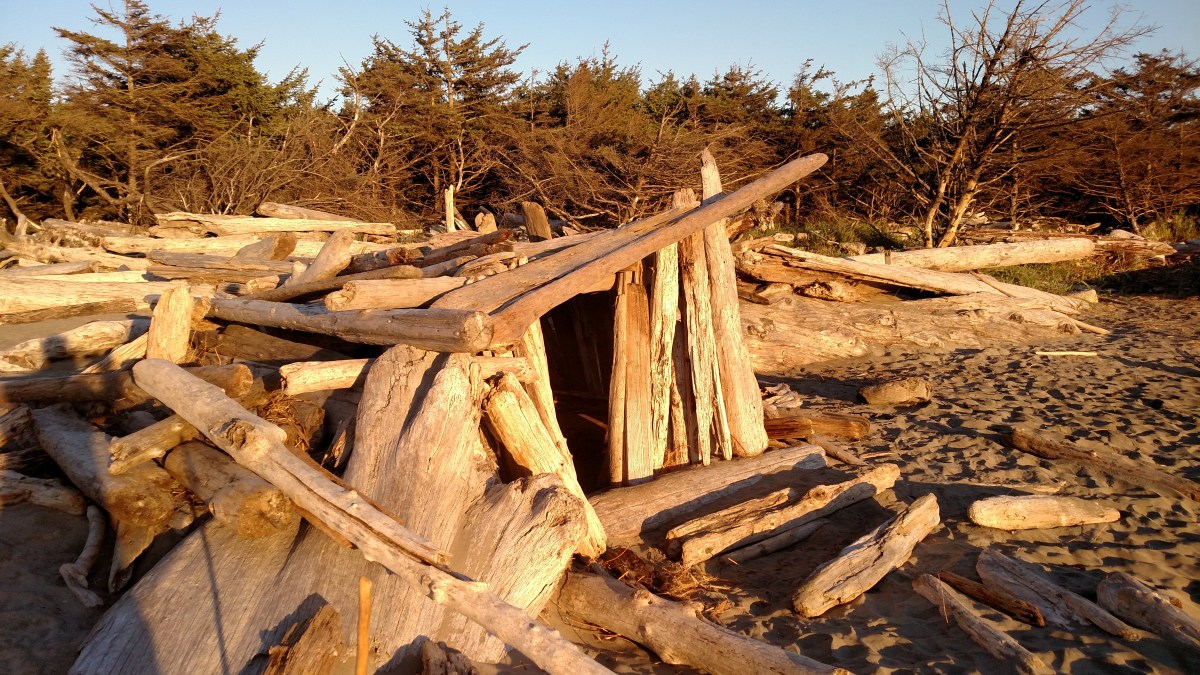
We really enjoyed visiting the coast. Alex, Dave, and the dogs loved the beaches. Jess enjoyed the beach, but mumbled grouchy things towards all the sand that was tracked into Abby. The major downside to the coast was the pervasive dampness (that and the lingering smell of fish in Abby). Nothing dried quickly. It was rather nice to return to a more arid climate.
This was an aggressive trip. On average, we drove 245 miles/day. Which is a minimum of 5 hours in Abby. We got to see a large number of attractions, but only in a superficial manner. For our next trip, our goal is to pick a major area of interest and some minor areas of interest for the route to and from. Drive in a rather direct fashion to our area of major interest and camp there for a week. This will allow us to do more exploring and hiking. Fortunately, we have all winter to choose a destination.
Our Pacific Northwest route.
Mileage and Fuel Consumption:
Total days: 17
Total miles: 4172.6
Total gallons diesel: 244.6
Average miles per gallon: 17.1
Best miles per gallon: 19.4
Worst miles per gallon: 13.8
Abby gave us a beautiful tank of 19.4 mpg as we came east across Wyoming. We may have had an aiding tail-wind, but we will take it.
Campgrounds:
For our campground summary post, follow this link.
This is a rather short brewery list, considering we drove through the Pacific Northwest. Alas, timing thwarted our best intentions to visit breweries. It would be a lot easier if breweries would open up in National Forest campgrounds.
What a park. From coastal bluffs to glacier peaks, this park is rich with diversity in all dimensions. Olympic National Park ecology is comprised of mountains, lakes, lowland forests, rivers, coast, and temperate rain forest. Mountain flora and fauna include glacier lilies, lupine, bistorts, tiger lilies, subalpine firs, and black tailed deer. At the coast, the tide pools are rich with sea anemones, sea urchins, sea stars, and limpits. The temperate rain forest receives more than 12 feet of rain a year, creating an environment for giant western hemlock, Douglas-fir, Sitka spruces, bigleaf maples, and a variety of mosses to thrive. Roosevelt elk and beers can also be found in the rain forest.
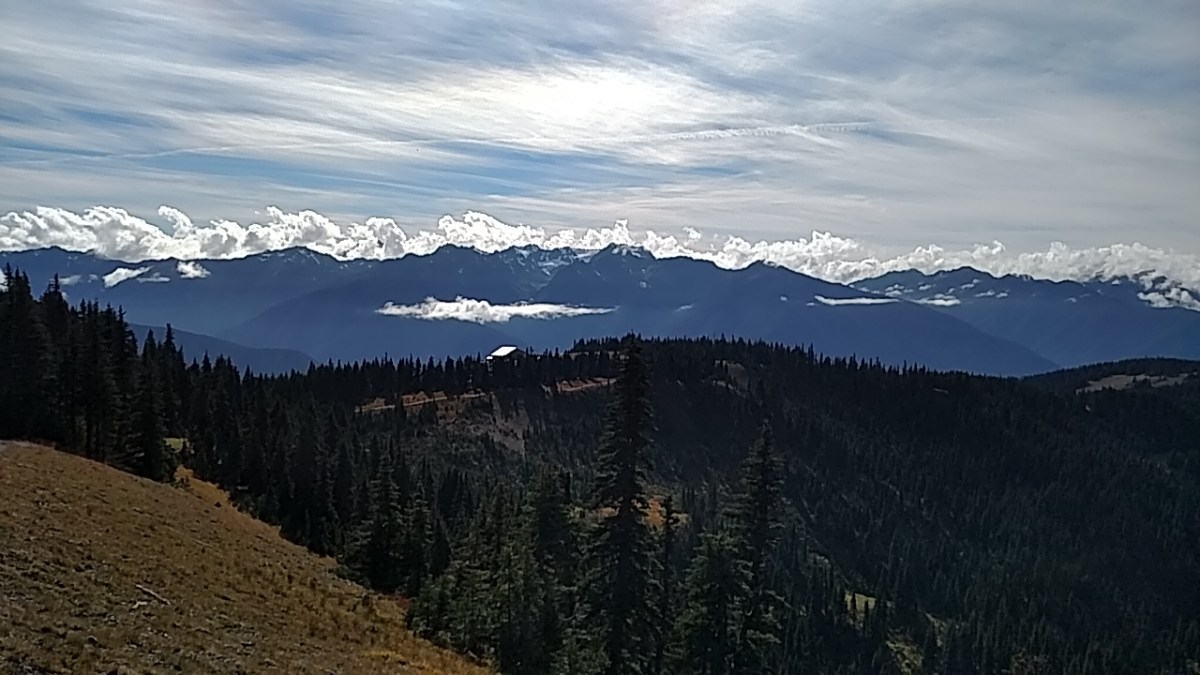
We started at the coast, camping at Kalaloch. We saw sand dollars and ctenophores on the beach. The salmon were running at the Salmon Cascades in the Sol Duc River to spawn (late September); they can also be seen in the Hoh River, but not until November/December. We hiked the Spruce Nature (1.2 miles – Alex walked the whole thing!) and the Hall of Mosses (0.8 miles) trails in the Hoh Rain Forest. The Spruce Nature trail had very little elevation change and was relative smooth. The Hall of Mosses had more of an elevation change, but after the initial climb, was relatively flat. There is even a trail to Blue Glacier (15 miles one-way); check out the elevation profile of this trail at the visitors center. We did not attempt the Blue Glacier trail. We saw Hurricane Ridge on a clear day, and it was gorgeous. Hurricane Ridge also serves a a squeegee for the moisture in the air. The west (windward) side has forests and is lush, while the east (leeward) side is arid and has few trees.
We could have easily spent two weeks here, hiking and exploring the area. The park has astronomy programs at Hurricane Ridge.
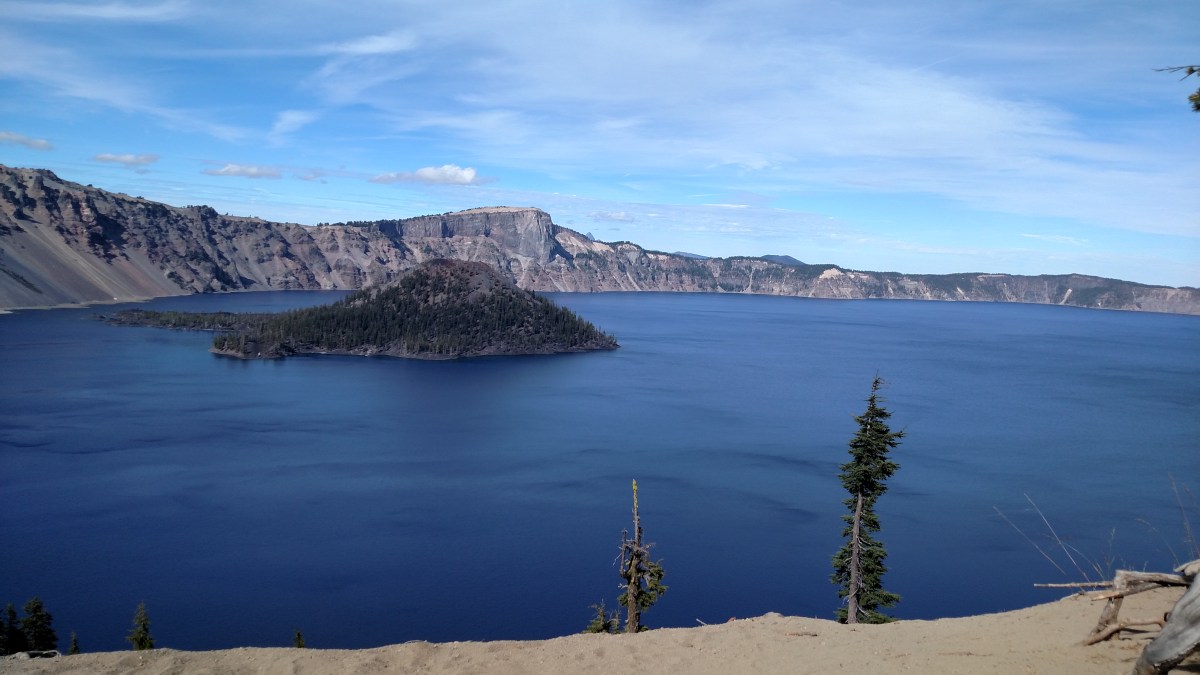
Crater Lake was formed when Mount Mazama, a 12,000-foot volcano, violently erupted approximately 7,700 year ago. No longer able to support its own weight once the magma chamber was emptied, Mount Mazama collapsed and a caldera was formed. This caldera then filled with rain and snowfall. Since no streams run into the lake, there is very little sediment to cloud the water.
The lake has thick mats of bacteria at depths where there is no light. There are also thick rings of moss, reaching depths of 400 feet, along the caldera walls. Hydrothermal pools have also been discovered, indicating a volcanic heat source. Mount Mazama may be dormant, but it is not extinct.
Our visit to Crater Lake was a drive through due to time constraints. There were also some closures in the park due to trail repair. The only campground for RVs is Mazama Village. The park is beautiful an is on our list to return to.
Gallery: Click on a picture to open the gallery.
The road leading to Crater Lake from the South.
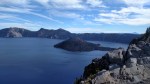
Wizard Island.
Wizard Island from a bit further out on the bluff.
Crater Lake is 1,943 feet deep and holds 4.9 trillion gallons of water.
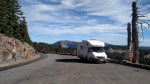
Abby on the road at Crater Lake.
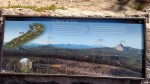
Peak guide at an overlook.
View of the peaks on a clear day.
Crater Lake ranges from 4.5 to 6 miles across
The water is so blue because other color of the spectrum are absorbed.
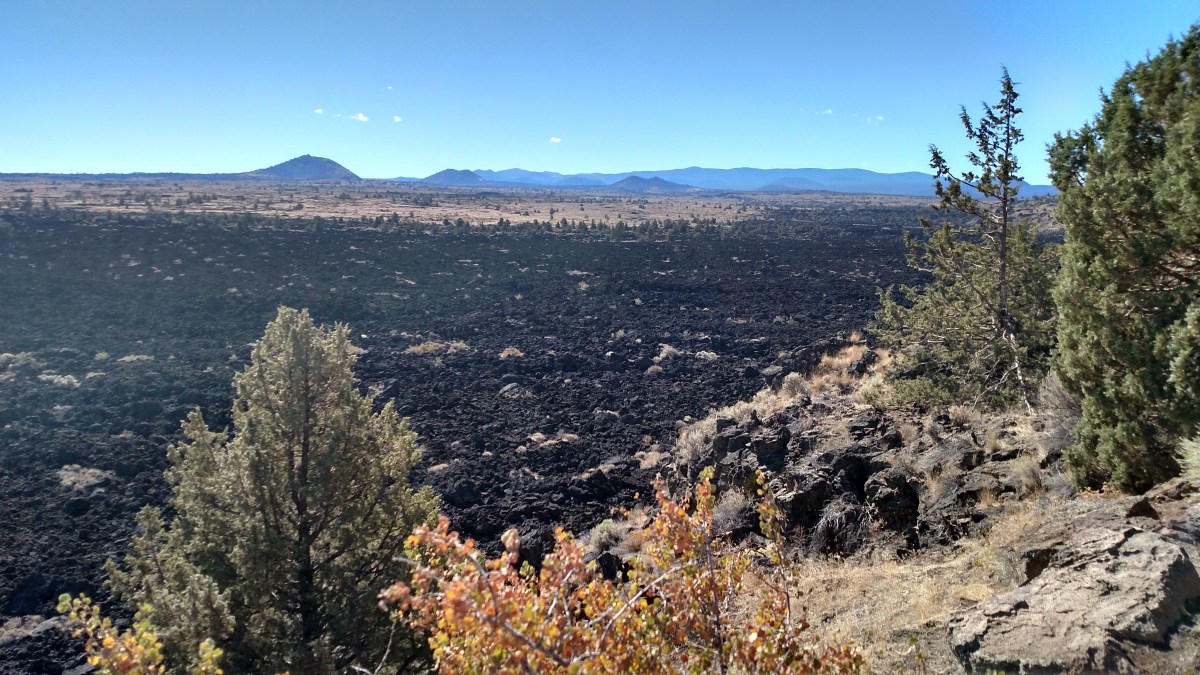
The Lava Beds are the result of the gentle eruptions from the Medicine Lake volcano, which has over 500 surface vents. The result of this gentle activity is a shield volcano with a low, gently-sloping profile. Eruptions dating back to 30-40,000 years ago formed over 700 lava tubes. Lava tubes are formed when the outside of a lava flow cools and the center remains hot. The hot lava center drains out, resulting in a pipe like cave. Caves can be stacked on top of one another due to multiple eruptions.
This region was home to the Modoc people and their ancestors for over 10,000 years. Moved from their homeland to the Klamath reservation in Oregon, some of the tribe returned home and fled to the natural defenses provided by the lava beds. It took the United States Army 6 months and 1,000 troops to capture less than 60 Modoc warriors and families. These families were then exiled to the Quapaw Agency in Oklahoma.
Lava Beds National Monument was established in 1925 to protect the land and the history of the Modoc people. In addition to the lava beds and caves, there is Tule Lake National Wildlife Refuge and Petroglyph Section. The Petroglyphs were covered by water as late as 1875. At this point water for Tule Lake was diverted for farm irrigation and the newly exposed land was converted to farm land. No longer protected by water, the petroglyphs are being damaged by vandals and the scouring action of wind blown soil.
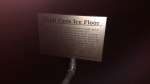
While at Lava Beds, we hiked the Mushpot Cave (motion sensor lights, paved path) and the Skull Cave; the Skull Cave ends with an ice cave that served as an important source of water in this arid environment. In addition to the caves, there are hiking trails throughout the park.
September was an excellent time to visit Lava Beds, temperatures were cooler and the sun was less intense.
More detail about the campgrounds our Pacific Northwest trip. We stayed at a couple municipal campgrounds (Campground by the Lake, Saratoga Lake Campground), a commercial campground, NFS and BLM campgrounds, national park campgrounds and dispersed camped.
Picture galleries are interspersed through out this post. Click on a picture to view in a new window.
Favorites:
Kalaloch Campground: Camping on the a bluff over the Pacific Ocean? Only way it would have been better was some sunnier weather. We had to play the walk-up game and camped the first night in B-17 (spur within the A loop). This site was spacious and relatively level. It was farther away from the bluff in the trees. On the second night we scored the bluff site A-25, a large rather private site with trees and bushes separating us from neighbors on both sides. A-27 is a very similar site. Some minor leveling was required in A-25. D loop prime sites are D-24 to D-30; D-24 is on the bluff while the other sites are across the road from bluff. All have clear views of the ocean.
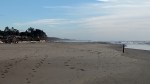
Looking down the beach towards the Kalaloch lodge.
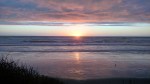
Sunset at Kalaloch
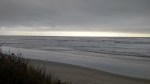
A stormy Pacific at Kalaloch.
Morning at Kalaloch after a stormy night.
Lone Fir Campground: Just off of WA-20 in the Okanogan-Wenatchee National Forest, this campground is tucked in amongst the trees with a creek running along the back campsites. These sites (~14 to ~20) are the prime sites and were occupied when we came through. We camped in site 23, which was level and a pull through. This was one of the larger sites at the campground. Sites 23 – 26 are large and would be top on our list for camping in despite the proximity to the (little traveled) road.
Water Canyon Recreation Area: This is a campground on BLM land near Winnamucca, NV. This canyon has a creek running through it. Along that creek are apsens; creating a stark contrast with the surrounding desert. After crossing onto BLM land, there is a campsite up the road approximately 1 mile. This site has along the creek and is lower than the road. It is a little hard to see because there is a site adjacent to the road, don’t be fooled, this a separate site in a prime location. Continuing another mile up the road, there is another site right along the creek in a large clearing. We didn’t level up on this site as well as we would have liked, but it nice. Alex was able to play in the creek and we hiked up the upper access road (closed in the winter). There are additional campsites accessible if you have a high clearance vehicle.
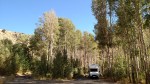
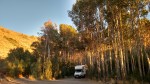
Abby at Water Canyon
A rather arid landscape across from our campsite.
Hiking the upper road in Water Canyon.
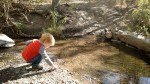
Alex playing in the creek at Water Canyon.
Sunset at Water Canyon.
Least Favorites:
None really. If anything we found South Beach State Park to be a little crowded, but it was close to town and had beach access. We weren’t on the beach, but close enough.
Also note that the bike path in South Lake Tahoe is a joke. It is narrow and unpaved at places. Where it is unpaved the transition is from bumpy black top to sand. If riding at night, a bright light is a must.
Biggest Pleasant Surprise:
Lava Beds National Monument: We did not know what to expect heading to this campground. The campground is at the south end of the park, and fortunately for us, we came in the south entrance. We arrived to find a nice mix RV and walk-in tent spots. We stayed in B23, one of the larger sites that could accommodate a RV in the mid-30 foot range. Most sites were relatively flat. Be sure to check the site stubs closely, we found that were several days expired; it doesn’t seem that the rangers come through that often to remove the expired stubs.
The campground was within a quarter mile of two caves (Indian Wells and Mushpot) and the visitors’ center. The visitors’ center had a great brochure outlining the difficulty of the caves. There were several trail heads within the campground or at the visitors’ center that provided access to a variety of caves.
View of wildfire from Lava Beds National Monument.
Scenes from Lava Beds National Monument campground.
Lava Beds in the morning.
Good morning moon! (Lava Beds)
Commercial Campground:
Camp Coeur d’Alene got our business because we needed to dump and our RV dump station app had already failed us twice. Combined with Alex waking up early from a nap, our goal to push further east was thwarted. Technically camped along the shores of Lake Coeur d’Alene and took Alex out on a paddle boat. There was plenty of space for Alex to run around. We dumped our black and grey tanks, filled up with fresh water, and did laundry to ensure clean underwear all the way home.
Dispersed Camping:
After a successful dispersed camping experience in Bighorn National Forest during our Northern Rockies trip, Dave was looking forward to another positive experience. This experience did not start out as well as it was difficult to determine where the Beaverhead-Deerlodge National Forest began and private property ended. It also didn’t help that we were on the fringes of the national forest and the road passed in and out of the forest.
We found a decent spot to pull off the road and set up camp. Slightly pitched to the left and front, we decided to walk further up the road. The view did not disappoint.
The night was a little creepy – Jess heard a four wheeler come down the hill and was positive it stopped near the RV. She then thought she heard someone(s) walking around the RV. The dogs did not bark, but she woke up Dave anyway. It was not a restful night, although everyone came out of the experience unharmed. If we had continued on MT-43E for about 10 more miles, we would have come upon a campground just shy of I-15. This campground was along the Big Hole River in a stand of trees. If you are in the area, check this campground out before going off into the wilderness.
Simply, sigh. We chose this brewery because it was easy cycling distance from our campground. We tried all the beers available and were underwhelmed. The lone bright spot was the California Cream Ale – not overly sweet, nice aroma and flavor. The Alpine Amber was a good example of a specific style, but slightly heavier on the hops than we would have expected for an amber. The Wit had very little spice character and was rather bland. The food was decent, nothing to rave about.
Jack Russell Farm Brewery
Located in Camino, CA, this brewery is located in the Apple Hill region, which refers to the 55 ranches located around Camino. Originally known for pear orchards, blight forced ranchers to diversify in the mid 1960s and is become the largest concentration of apple growers in California. The area is home to Christmas tree growers, wineries, vineyards, and a spa. We weren’t prepared for this area to have so many activities and only planned enough time to visit the brewery. Despite its name Apple Hill has year round activities, so if you are going to be in the area check out this site to plan your trip!
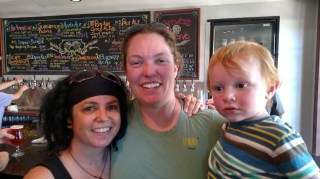
Teri, Jess, and Alex and Jack Russell.
Back to Jack Russell! One of Jess’ master brewer classmates, Teri, works for Jack Russell, so we decided to stop in and visit. Since we didn’t do any research into the area, we were surprised to see all the people and activity surrounding the brewery (see previous paragraph). Since it was lunch time, we were especially happy to see the Hotdogger from Davis, CA! This was part of our Saturday farmer’s market routine – buy some fresh California veggies and fruit and chow down on a hot dog or Polish sausage for lunch before riding home. The Hotdogger was as good as we remembered.
The beers on tap at Jack Russell.Where’s Alex?!
So beer! There were fifteen beers on the board and lockers for Alex to play in, so we ordered tasters of them all! (Note – the intent of the lockers was not for a toddler to play in them, but they were Alex sized and he found them greatly entertaining.) We enjoyed all fifteen beers. There wasn’t a bad one in the bunch, not even a meh beer by our tastes. The only beer where there was a minor difference of opinion was the Vanilla Stout. Jess wanted a smidge more roasted character to the beer, Dave enjoyed it as it was brewed. We left with a growlerette (32 oz) of the Vanilla Stout and enjoyed it with s’mores by a campfire. This was a truly minor quibble on Jess’ part over a well executed beer line up. Some other beers we found to be striking was the Pumpkin Spice Ale – it smelled like pumpkin pie fresh out of the oven, but the spice flavor was not overwhelming, just enough there to satisfy. We enjoyed the Tangerine (light and refreshing) and the Captain Boomer’s IPA (well balance malt and hop character, bitterness was not overwhelming). We left with growlerettes of the Tangerine and Captain Boomer’s IPA in addition to the Vanilla Stout. The only reason we did not leave with more was limited storage space in our fridge.
We were glad we took Abby down the hill from Lake Tahoe to visit Jack Russell. It was great to see Teri, even though the steady stream of customers made it hard to catch up. It is a fantastic brewery producing excellent beers. Located in a family friendly area, there are many activities to occupy one’s time. We wish we had planned properly, but look forward to a return trip.
When we selected Newport, Oregon as a destination, it was not because of Rogue. It was a larger town that had a laundromat, an aquarium (which we did not take Alex to due to poor time management), and a state park with easy beach access (South Beach State Park). So we were excited that Google search results returned Brewer’s on the Bay – the restaurant within the Rouge brewery. It was just a 8 minute bike ride from the campground! The situation had the feel of a well executed plan!
Has Dave been making beard beer and not telling Jess?
We had to walk through part of the brewery to reach the restaurant; just a glimpse of the facility, but great to see. Upon reaching the restaurant (above the gift shop) we snagged a seat by the window that also had easy access to a power outlet so we could plug in Alex’s portable DVD player. Our taster consisted of Marionberry Braggot, Hazeluel Choctaulous, Mocha Porter, Rogue Farms 4 Hop IPA, Chocolate Stout, Dead Guy Ale, and the Cherry Habenero Golden Imperial Ale. We discovered the marionberry is to Oregon as the huckleberry is to Montana. It is in everything and it is tasty (also as a sauce for their deconstructed cheese cake). We enjoyed every beer on the taster. The Cherry Habanero was intriguing with the sweet from the cherry being the first taste, followed by a heat of the habanero. Jess is a fan of heat more so than Dave, but the heat was too much for her to enjoy more than what was in the taster. We were pleasantly surprised by the 4 Hop IPA; we were more familiar with Rogue’s double chocolate stout, but found that the IPA was well balanced and very drinkable.









































 Wandervogel with the McElvains