
A pictorial diary of our trip.


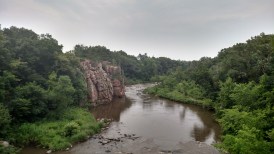


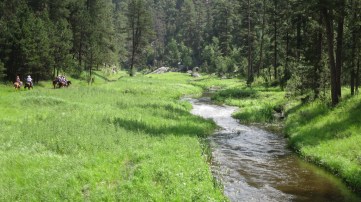


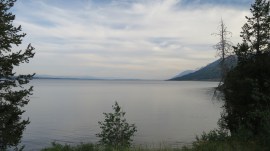





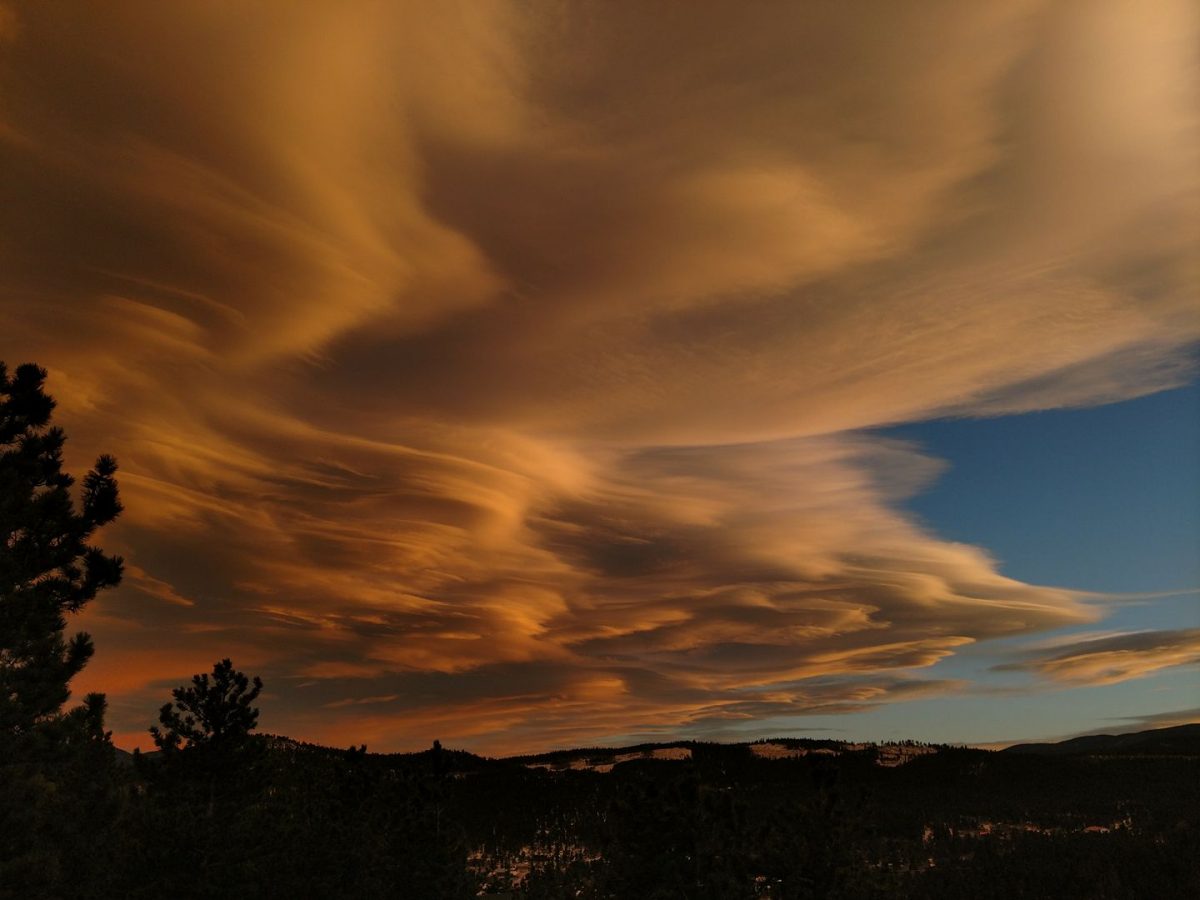
A pictorial diary of our trip.
Our 2015 trip out west was ambitious. We were always on the move and didn’t have many rest days to explore. However, we did manage to include a few fun side trips into our itinerary.
Little Devil’s Tower; Custer State Park, SD:

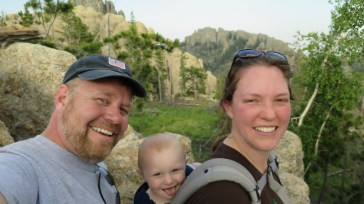
The trail head for this hike in Custer State Park (see trail map) originates at Sylvan Lake. We did not finish this hike because of time constraints – we had to make sure we got back to our campsite before dark. We really enjoyed the hike and wish we had planned our time better. Multiple trails leave the confines of Custer State Park and enter the Black Elk Wilderness. What was really unusual compared to other parks is that pets were allowed on the trails, but had to be leashed. It was a nice experience being able to take Penny and Chewie with us. We also had Ergo as Alex’s carrier; he was getting to heavy to be able to hike long distances comfortably in this carrier.
Mount Rushmore, SD:

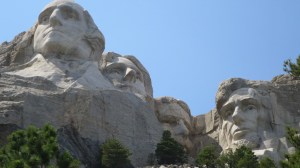
Conceived by South Dakota historian Doane Robinson, carving likenesses of famous people in the Black Hills region was done to increase tourism. The sculptures were done by Danish-American Gutzon Borglum and his son, Lincoln Borglum. The elder Borglum was instrumental in the selection of Mount Rushmore (the original site, the Needles, had poor quality granite and was opposed by Native Americans) as well as selecting the presidents (George Washington, Thomas Jefferson, Theodore Roosevelt, Abraham Lincoln) to be carved in the mountain.

Initially, the presidents were supposed to be depicted from head to waist, but poor quality rock and a lack of funding resulted in the monument we are familiar with today. Construction began in 1927 and ended in 1941, notably with no fatalities.
We walked the trail with Alex, starting down the Presidential Trail towards the Sculptor’s studio. This path wound around and took us under the sculptures. This route had numerous steps, which tired Alex out quite nicely. We completed our loop and returned to the Avenue of Flags; the remainder of the trail after the sculptures was handicap accessible. We ended our visit with vanilla ice cream made following Thomas Jefferson’s recipe.
Durango & Silverton Narrow Gauge Railroad; Durango, CO

Built starting in the fall of 1881, the line was constructed to haul silver and gold ore from the San Juan Mountains in southwest Colorado by the Denver & Rio Grande Railway. The line was completed by July of 1882 and began to haul passengers and freight. The narrow gauge was selected by William Jackson Palmer, a former Union General and experienced railroad man, as it would be well suited to the mountainous country and would have lower construction costs.
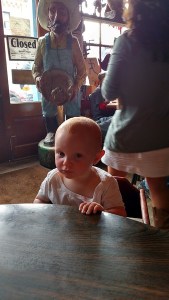
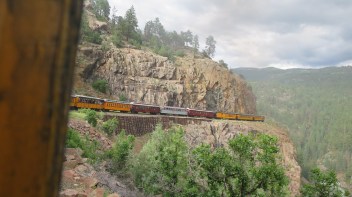
We took the bus from Durango to Silverton and rode the train back. We kenneled the dogs at Durango Pet Resort. Parking the RV was a bit tricky and we were very lucky to make the bus up to Silverton. Our tour guide was knowledgeable and the bus ride flew by. We ate lunch at Handlebars Restaurant & Saloon; their burgers were pretty good. If our memory serves, they brewed their own beer and it was meh.

The ride back became more of an adventure than we expected. One of the engines broke down bringing a train up to Silverton and the 12:30 train was delayed so the engine could take the 2:30 train back to Durango as well. Needless to say, the double length train did not move very quickly (train ride back took 5 hours). We were not prepared for the extended trip and had not packed enough diapers or food for Alex. Additionally, the train still made all the stops at various trail heads to drop off and pick people up. A really neat option, but it was frustrating after a long day. We didn’t get back to Durango until after the kennel closed, but they had an after hours pick up option and we were able to retrieve Penny, Chewie, and Buster.
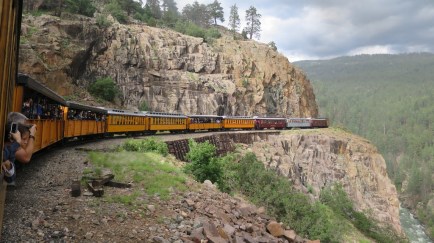
It was a beautiful trip.
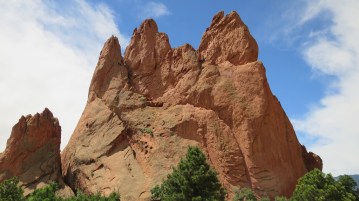
Garden of the Gods; Colorado Springs, CO

Our timing for this visit was poor. We arrived soon after Alex fell asleep. He was not in the mood to go on a long walk through the Garden of the Gods. It was also a hot, sunny day, so we took the dogs with us (allowed); they did not make the circus easier to manage.
We took a short hike and then returned to Abby for lunch and to push on North.
Carousel of Happiness; Nederland, CO
The Carousel of Happiness was built by a Marine Vietnam veteran, Scott Harrison. The frame was from the Saltair Park carousel that had its animals removed. Over the course of 26 years, Mr. Harrison hand carved 50 animals for the carousel, of which, 35 can be ridden.
Alex seemed a bit uncertain about his first ride on the carousel. The carousel is beautiful and is worth the visit.

We had the pleasure of traveling through Yellowstone on the Fourth of July weekend, 2o15. This was one of the most disappointing stops of the trip. Being a holiday weekend, the park was extremely crowded. We would visit Yellowstone again, but during the shoulder season when crowds would be less teeming.
We had a reservation for a single night, July 3, at the Bridge Bay campground. This campground is essentially and open field with tightly spaced spots and no hook-ups. Most spots are relatively level. Firewood was available for purchase at check-in. As state in our summary post, the bathrooms were atrocious. Overall, the vendor running the campgrounds and amenities was less than impressive.

Perhaps the single most frustrating things were the tourists. What do we mean by tourists? People who ignore the signs and rules stated to protect them (selfies with bison, straying from boardwalks around the hot springs) and generally oblivious behavior. A prime example, we
stopped to stopped at Dragon’s Mouth Spring as we were driving across the park. There was a bison laying next to the restroom building. People were walking within feet of the animal to take a selfie. The bison eventually had enough of the paparazzi, got up, and ran through the parking lot. The panic was capped by a woman screaming (imagine this in a New Jersey accent), ‘Larry, LAARRRYYY!! The bison! Look out for the bison!!”. Larry, clearly no where near the bison’s path of travel, waved at his hysterical wife. Panicking and further startling a wild animal, not the wisest plan.
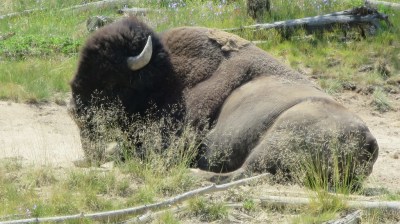
Traveling across the park was also slow going. The speed limit is 35 and in some of the more popular areas it drops to 25 mph. This is made even worse by the people ignoring posted signs and stopping in the middle of the road (rather than pulling off on a pull out as advised) to take a picture of some animal that caught their attention. Again, a fantastic example of oblivious tourist behavior.

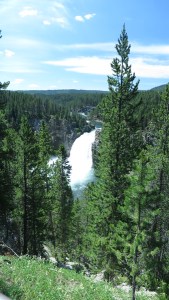
The negatives were frustrating and took away from the beauty of Yellowstone. There were some very nice handicap accessible paths to a variety of features that we were able to take Alex to in either his wagon or stroller. As with most national parks, dogs were not allowed on trails. Which is frustrating and limits what we can see. However, these are limitations we accept when traveling with Penny, Chewie, and Buster. And seeing how most people can’t follow simple rules, allowing dogs on trails would be an utter disaster.
We couldn’t move without trying breweries along the way. Unfortunately, we had to abort a couple of breweries as well. Alibi Ale Works in Incline Village, Nevada doesn’t like Alex’s type coming through their doors, which we respect. We had heard good things about Alibi, so we were disappointed that the logistics didn’t work out.
Due to the trials and tribulations of our journey, we only visited two breweries.
Triple Rock Brewery and Alehouse, Berkeley, CA
How did we end up in Berkeley on our move to Colorado from Davis, CA? Our geography and map reading skills are not that atrocious, really and truly. Dave’s cousin and her family, who live in New Zealand, were in the area on a college visit. It has been several years since we last saw them, so we took the opportunity to visit (Wonder why it took us 2 days to drive a net of eight miles? A side trip that was a lot of fun). They told us to chose a place for lunch, and of course we selected a brewery.
We tried the IPAX Ale and the Black Rock Porter and were pleased with both. The actual appearance, aroma, and taste were in-line with the menu descriptions of the beers. The Reuben and pulled pork sandwiches were also executed well.
Wasatch Brewery, Park City, UT
We arrived in Park City, UT around lunch time. Fortunately for us, Wasatch Brewery was nearby. After parking Abby and the trailer in a free public lot (we used up 6 spaces, thankfully it wasn’t busy), we drove the car down to the main street of Park City and parked near Wasatch. We were able to get a shaded seat on the patio and got to relax while Alex enjoyed train videos.
We tried the Polygamy Porter which had a clever tag line of ‘take some home to the wives’. The color was excellent and the aroma was robust with chocolate and roasted notes. The flavor was disappointing. Grainy at best, it was surprisingly thin, especially after the aromas were the perfect set up for a thick bodied porter. The Evolution Amber Ale was the second beer we tried. It was an improvement over the Polygamy Porter, but we have brewed better at home. Overall, beer was meh. Food was very well done and the pickled tomatoes on the steak salad were a surprise highlight.
No trip would be complete with out some mechanical issues. Especially on a holiday weekend traveling the loneliest road. Fortunately, the check engine light and the flat tire were not as serious as the failed turbo resonator or transmission breaking.
Check engine light:
The check engine light came on coming into Carson City, Nevada after dropping down the Sierras. Dave used an OBDII reader to obtain the error codes associated with the check engine light.
Error codes: Cam position sensor, O2 sensor error
Fortunately, where we pulled over in Carson City was not far from the Dodge dealer. The shop manager reviewed the codes and said that the cam position sensor can ‘hiccup’ especially when traveling from high to low altitudes. This results in a cascade effect that causes the O2 sensor to error as well. He was happy to report that as long as the check engine light wasn’t flashing, we could continue to drive Abby. If we wanted peace of mind, we could have it checked out, but the soonest he could get to it would be Tuesday. As much fun as a two night minimum in Carson City sounded, we decided to push onward. We bought a Good Sam towing membership.
Total time lost: 1 hour
Repair difficulty: Easy, it was simply getting advice from a shop guy. Google indicated that replacing the sensors was not difficult and could be done in a parking lot or campsite. No auto part stores had the parts in stock. Abby is due for a thorough tune-up, including a transmission flush, at the end of this trip. We are going to pay the money and let a Dodge dealer give Abby some TLC.
Flat tire:
 Our flat tire occurred approximately 40 miles west of Austin, NV. We were losing approximately 2 lbs of pressure every mile. How did we know? Dave purchased and installed EEZTire Monitoring system that reports the pressure in each tire via RFID. Fortunately, the Edwards Creek historic marker was close by and we were able to pull over in a safe place to change the tire. As Dave changed the tire, Jess wrangled the dogs and Alex, with marginal success. The dogs had to be returned to Abby. Alex ran around with tools key for changing the tire and found every bit of dirt on the Abby and transferred it to himself. Inspection showed that the valve stem had failed. To add to the fun, the spare tire and the other dualie tire needed to have their pressures increased. Our 12V electric pump burned out; fortunately, we had a bike pump with the appropriate fitting in the trailer.
 After completing the tire change, we stopped in Austin, NV to fill Abby up. Dave inquired about tire repair and was directed to Wayne, the tire guy. He provides 24/7 service for this isolated area and was able to fix the tire.
Total time lost: 2 hours
Repair difficulty: Easy. If you know how to change a tire on a car, you can change a tire on an RV. Parts are just bigger and heavier, technology and theory are the same. This is a key skill otherwise you will be waiting for several hours in the sun for assistance. And there may be no cell service.
Our Colorado move has been rather light on state park/national park/national forest campgrounds. We quickly discovered that the holiday weekend results in spike in usage and you have to be in extremely early to get a walk-up spot, and there may not be one since most spots are booked for the entire weekend. 75% our nights on this trip were spent in commercial campgrounds. This was not bad, just different. And truth be told, not entirely unwelcome. We had full hook-ups and were able to run the A/C, which made sleeping bearable with days in the mid-nineties and above.

History:
Great Basin National Park was the jewel of our trip. Found on multiple hidden gem lists, the rangers said that the secret is getting out. This national park is just a representative piece of the Great Basin, which covers the majority of Nevada, half of Utah, and parts of eastern California, and south eastern Oregon. The region was named the Great Basin because it has no hydro-graphic connection to the ocean. Elevation greatly influences the flora, as temperature decreases and precipitation increases. These conditions result in forests composed primarily of piñon and juniper varietals with stands of limber pine, Great Basin bristlecone pine, cottonwoods, and quaking aspen interspersed. Similar to Chisos Basin in Big Bend National Park, fauna are rare species isolated after the last ice age. Great Basin is also a gold-tier international dark sky park.

The Great Basin region was inhabited by the Shoshone, Ute, Mono, and Northern Paiute tribes. Europeans first explored the region during the Spanish colonization during the 18th century.
Activities: Lehman Cave tours, hiking, caving, star gazing
Lehman Caves is part of Great Basin National Park and can be seen on a guided tour only. We went on the 60 minute Lodge Room Tour (allowed children under 5). While not as majestic as Carlsbad Caverns, it is an extremely intimate and educational tour. This cave has features actively forming, so one must be extremely cautious and not touch any of the formations. Also, they are very concerned with protecting their bats from White Nose Syndrome, so be aware that items worn in other caves that are unlikely to be washed, need to be sanitized. Review all the tour guidelines in advance to ensure that you don’t bring any contraband material with you.
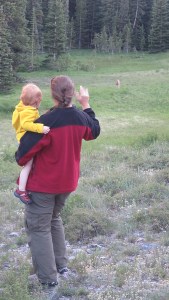

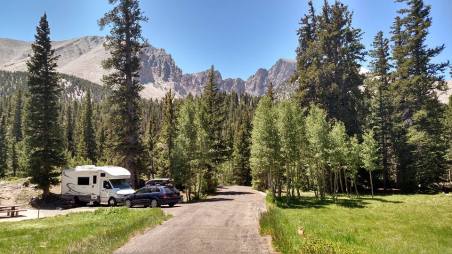
Our campsite (number 26) at Wheeler Peak Campground was idyllic. Over a rise behind our campsite was a creek with a meadow nearby. Next to our campsite was another alpine meadow. We observed a deer grabbing its evening meal in the meadow by the creek. There were several trail heads available at the Wheeler Creek Campground  – Lehman Creek, Bristlecone, Glacier, Mountain View Nature (accessible), Alpine Lakes Loop trails. Other hikes are accessible at different points in the park. We were hiking the Bristlecone trail when Jess fell and lacerated her knee. This resulted in us breaking camp and driving to Delta, UT (100 miles!) to the nearest hospital with decent service. For more serious injuries, it is a Medivac flight to Salt Lake City ($40,000), so be aware that this is an isolated area. We did not finish our hike, but for more detailed information regarding the Bristlecone pines, check out this article and video from Atlas Obscura. And, the best part of all, there were rocks.

Overall: We really enjoyed this park. The scenery is picturesque and while it is becoming more popular, the usage is light. We look forward to going back and making Jess wear knee pads during hikes.
We have arrived in Loveland, CO and have internet! This is no small feat considering we are dealing with Xfinity, the re-branded Comcast. Note to all businesses, changing your name will not wash away the stink of abysmal service. You eventually will have to come up with a new name because you have not solved the underlying reasons for customer dissatisfaction. Any hoo . . .
Our move to Colorado from California did not go as smoothly as we hoped. Moving on the Fourth of July weekend and having to go through a major tourist destination does not result in good time on the road. We spent more time in commercial RV parks than typical for us, but options were limited in some of the areas we were traveling.

The trip covered 1,191 miles and took us over the Sierras, across the loneliest road (US-50 in Nevada), and through southern Wyoming. Abby’s mileage pulling the trailer ranged from 13.5 over the Sierras to a whopping 18 across Wyoming (tail wind aided). Dave drove Abby while Jess followed with Alex in car.
We chose to come across I-80 because the climbs were less severe than I-70 through Colorado. We did not count on the 35 mph tail wind in Wyoming which had an extremely positive effect on Abby’s mileage. Coming through Lake Tahoe on US-50 was a critical error and resulted in frustrating traffic that added 90 minutes to our trip.
Campgrounds:

Emergency Rooms:
These last 5 months have absolutely flown by. Abby is packed and we leaving for Colorado.
Our time in California wasn’t all that we had hoped. We had hoped to travel more on the weekends, see more of the state. The Master Brewers Program was intense and weekends were spent studying. In hindsight, entire weekend trips would not have been wise, but day trips were feasible. We were within a couple hours drive of some amazing attractions (coast, Sierras, San Francisco, state parks). If we had given the situation more thought, we would have been able to enjoy the surrounding attractions much more.
What we will miss


What we won’t miss
So, fare thee well California. We wish a very rainy winter to help alleviate the drought and build a fantastic snow pack. Our plan is come back for vacation.
Route: US-101S
 We did not do this drive in one day. It actually took us two. We stopped and stayed at Mad River Rapids RV Park (clean, nice bathrooms, laundry, just a little too developed for our preferences) in McKinleyville, CA the night of June 21st. Cell reception was critical for the morning of the 22nd because Jess had a phone interview for a job. The saving grace of this stop was Six Rivers Brewery, just 5 minutes away from our campground. We enjoyed their beers.
Just south of Eureka, we debated on taking Mattole road along the lost coast. It is a beautiful drive; we have done it before in a rental car and motorcycle. However, it is twisty with lots of up and downs. We decided not to abuse Abby that badly a few weeks before our move to Colorado. We decided to enjoy the drive along Avenue of the Giants for the scenic portion of our drive.
History: Westport and Union Landing were towns supported by the lumber industry. A complex wharf and chute system was used to load the schooners anchored beyond the dangerous rocks with lumber, tanbark, shingles, wool, oats and railroad ties from the bluffs. The town struggled through boom and bust cycles, and the Great Depression diminished Westport further. The town survives today, unlike other lumber towns along the coast.
Campgrounds:
With our late start on the 22nd, we started to look for camping in Humboldt Redwoods State Park. We were shut out the previous night at Prairie Creek Redwoods State Park; this park is very popular and after hiking to Patrick’s Point, it was clear why. Make a reservation, it will be worth it. We were cautiously optimistic about finding a spot in Humboldt Redwoods. The Burlington campground, where we (minus Alex) camped in 2010 was full, and the park staff recommended Hidden Springs. This was a fantastic recommendation. We selected site 9, which was level and had a nice area for Alex and the dogs. There was some road noise, but the number of cars traveling on the road decreased significantly after dusk.
We got off to an early start on Thursday and as we drove by Westport Union Landing State Beach we saw campsites set up. We stopped to investigate and discovered that this is a first come, first serve campground. We snagged a spot for two nights. Initially, there looked to be a limited number of spots, but there are three camping areas.
Activities:

Various hiking trails are available at Humboldt Redwoods State Park and Prairie Creek. Prairie Creek will have ocean view trails. At the Eel River swimming hole in Humboldt Redwoods State Park, Alex took great joy in throwing rocks into the river. It is an activity he enjoys.
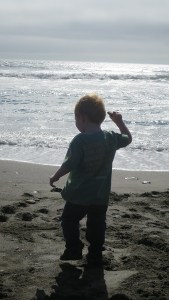
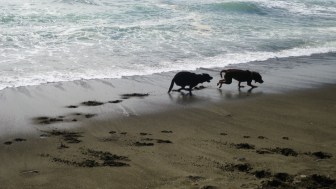
 Westport Union Landing State Beach has, well, the beach. This can be walked to and at low tide you can find sand crabs, crabs, giant anemones, and mussels. Alex took a little bit to warm up to the beach and preferred to walk on the harder sand exposed during low tide. Once he discovered this surface, he was eager to run up and down the beach. The dogs were excited to frolic in the surf.
Fort Bragg is about 15 miles down the road. Fort Bragg is the home of North Coast Brewing Company and their very tasty beers. There is a tourist train, called the Skunk Train, that takes riders on a forty mile tour through redwoods and mountain meadows. We missed an opportunity to take Alex on a train ride that he would have loved. There is also Glass Beach, where beauty has resulted from a former city dump.
Overall: Fantastic camping spot. Need to be quick to grab a site. The proximity to Fort Bragg provides extra activities. We could have spend our entire trip camped out on the bluffs.

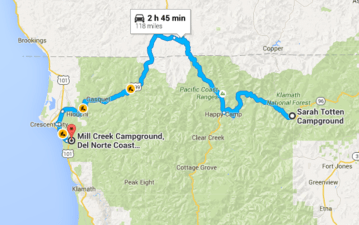 Route: CA-96W, Indian Creek Road, US-199S
We got off to a relatively early start because the day’s activities included grocery shopping and laundry! We were westward bound on CA-96W until Happy Camp. We stopped at the Frontier Saloon and Cafe for second breakfast; Dave finally staged his uprising against granola and yogurt and insisted we stop. Portions were generous, food was good. Bacon was amazing – thick cut, not overly salted. Stop in if you are in town.
Our route took us through a remote area; the steep mountain slopes are not conducive to building. The road was twisty and when we crossed into Oregon, Abby earned another state badge. We debated on detouring to the Oregon Caves National Monument and Preserve, but it was 45 minutes out of our way and we needed clean undies. We turned south to Crescent City. We arrived and wanted to stop and Port O’Pints, but they didn’t open until 2. And there was no food as far as we could tell. Pre-made salad from Safeway for the lunch win!
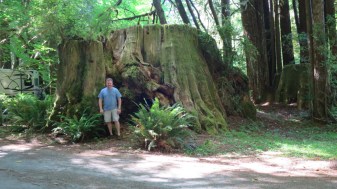
History: Redwood logging began in 1851, as the gold rush waned. Technological advances made it easier and faster to harvest the large trees. In 1920, key groves were preserved by the State of California. In 1968, Congress created Redwood National Park, protecting the world’s tallest trees and Redwood Creek’s salmon fishery.
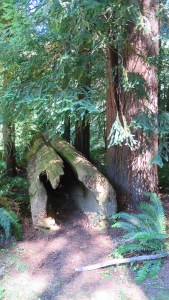
Coast redwoods have been recorded at 370 feet, almost 70 feet taller than the giant sequoia. There are no known killing diseases and are resistant to insects, believed to be the result of high tannin concentrations, which also provides the red hue to the wood. Fog, created by the hot air of the central valley pulling moisture laden ocean air towards the interior of CA, is key to the survival of the coastal redwood.
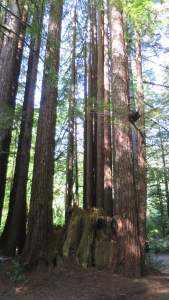
Redwood National and State Parks are a cooperative management effort between the National Park Service and the California Department of Parks and Recreation. Redwood National Park, Jedediah Smith Redwoods State Park, Del Norte Coast Redwoods State Park, and Prairie Creek Redwoods State Park are part of the cooperative effort and form a World Heritage Site and International Biosphere Reserve.
Campground: We stayed at Mill Creek campground in Del Norte Coast Redwoods State Park. We were lucky to get a walk-up site, number 41. Sites 40 through 42 are spaced the closest and receive the most sunlight. The sites are level and have easy access to Mill Creek. Sites 39 and 55 are prime sites, spacious and well separated from neighboring campsites. Overall, most sites in the camp well spaced. There are some tent only sites that are extremely secluded – you hike to the tent platform through a tunnel in the foliage.
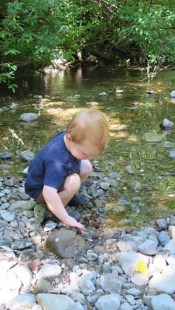
Activities: Fishing in the park tributaries of the Smith River for cutthroat trout and hatchery steelhead is permitted. Mill Creek is closed to fishing part of the year. A license is required.

There are a variety of trails for hiking in the park. The Trestle Trail Loop circumvents sites 1 – 74. Off of this trail, one can access the Adler Basin, Saddler Skyline, and Hobbs Wall (via Saddler Skyline) trails. The California Coastal Trail, which is 1200 miles long, runs through the park. Also in the park is the Damnation Trail, which was used by the Tolowa Indians to reach the ocean to gather shellfish and seaweed. This trail drops 1,000 feet over two miles through old-growth redwoods and Sitka spruce. We thought about attempting this hike, but wisely did the math in advance. The average grade on the trail is 10%. We opted for the Trestle Loop Trail instead. This trail was a combination of a relatively flat and wide path (good for Alex to walk a bit) and some narrow, steep hillside hiking (good time to contain Alex in the pack).
Overall: This was a fantastic campground and would be a fantastic place to set up home base for a couple of weeks and explore the coast. There are endless day trip possibilities. Also, the proximity to Crescent City means it is easy to restock food and clean clothes.


 Wandervogel with the McElvains